
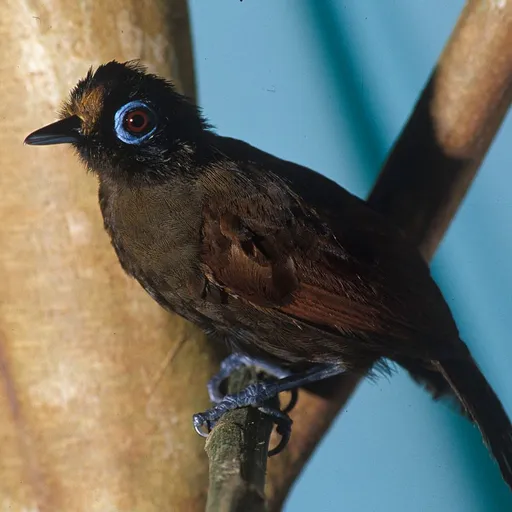
Hairy-crested Antbird
Rhegmatorhina melanosticta
Least Concern
Listen
XC250911 · Niels Krabbe · Napo: Napo Galeras, Ecuador · CC BY-SA 4.0
Overview
The hairy-crested antbird (Rhegmatorhina melanosticta) is a species of bird in the family Thamnophilidae, known as the typical antbirds. It is found across parts of Bolivia, Brazil, Colombia, Ecuador, and Peru, and is currently assessed as Least Concern by the IUCN.
Identification
- Length of 14 to 15 cm with a weight between 29 and 33 g, featuring a bushy crest in adults and a large pale bluish-white ring of bare skin around the eye.
- Males of the nominate subspecies display an olive-tinged gray crest, olive-brown upperparts with rufous-edged wings, and black lores, face, and throat; females have additional short black bars with cinnamon-rufous edges on their back.
- Song described as a slow series starting with high, sharp, fluted notes that descend to drawn-out, grating notes, or as wheezy, nasal whistled notes like 'wheeeyr, wheer-wheer-wheer'.
Habitat
Primarily inhabits the understorey of humid terra firme evergreen forest, though it also occurs in transitional forest near seasonally flooded areas. Its range extends from south-central Colombia through Ecuador and Peru into Brazil and Bolivia, reaching elevations of up to 1,350 m in Peru.
Diet
An obligate ant follower that feeds on arthropods fleeing foraging army ant swarms, such as those of Eciton burchelli. It typically forages individually, in pairs, or in family groups, perching within about 1 m of the ground and sallying or pouncing to the ground after prey.
Did you know?
The specific epithet melanosticta is derived from Ancient Greek, combining melas meaning 'black' and stiktos meaning 'spotted'.
Sources
- Wikipedia · CC BY-SA 4.0
- Wikidata · CC0 1.0