
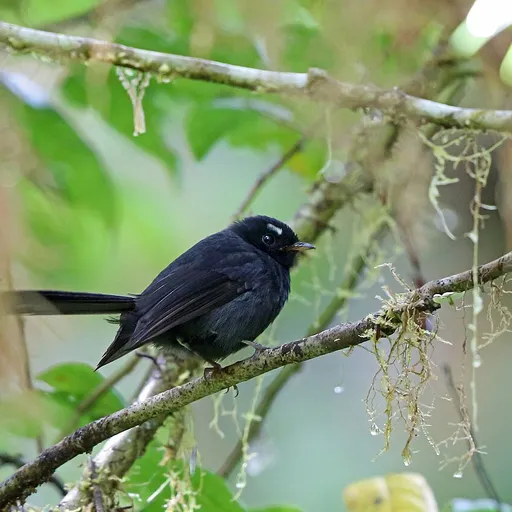
Black Fantail
Rhipidura atra
Least Concern
Overview
The Rhipidura atra is a small songbird belonging to the family Rhipiduridae and is endemic to the highlands of New Guinea and the nearby island of Waigeo. This species was named by the Italian naturalist Tommaso Salvadori in 1876, deriving its specific name from the Latin word for dull black.
Identification
- Males possess almost entirely black plumage with a small white supraorbital spot above each eye and white underwing coverts.
- Females are quite distinct with rufous upperparts, rusty-orange underparts, and a rufous tail featuring two black central feathers, while immature birds resemble females.
- The bill and legs are black in the male, with a dark brown iris.
Habitat
This bird inhabits the dense understory of tropical moist montane forests between 700–3,200 m, most commonly between 1,000–2,150 m. At higher altitudes, it is replaced by the dimorphic fantail, although considerable overlap between the two species has been detected.
Diet
The black fantail feeds on insects such as beetles and caterpillars in the forest understory, catching most prey in the air while gleaning a quarter from vegetation. The species also joins mixed-species feeding flocks.
Did you know?
Early accounts suggested the nests of this species were placed close to the ground, but they have since been recorded up to 12 m off the ground in the forest mid-storey. A single white egg, speckled with purple-grey and olive-brown, is incubated by both parents.
Sources
- Wikipedia · CC BY-SA 4.0
- Wikidata · CC0 1.0