
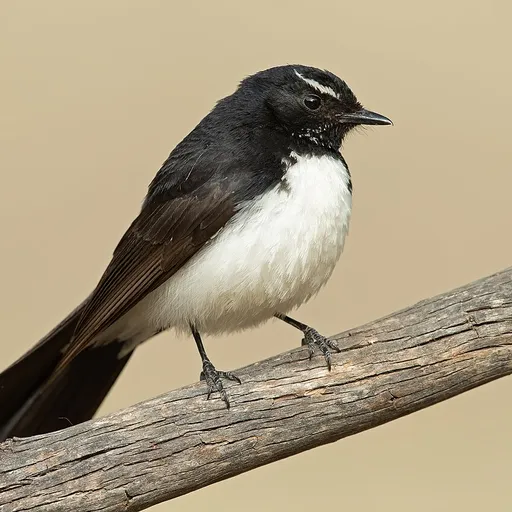
Willie Wagtail
Rhipidura leucophrys
Least Concern
Listen
XC1069963 · Rob Nicholson · Goondiwindi Botanic Gardens, Goondiwindi, Queensland, Australia · CC BY 4.0
Overview
The willie wagtail is a small passerine bird native to Australia, New Guinea, and nearby island regions. It is a common and familiar species that thrives in most habitats except thick forests, having successfully adapted to human-altered landscapes.
Identification
- Plumage: Contrastingly coloured with almost entirely black upperparts and white underparts; features a white eyebrow and whiskers.
- Size: Measures 19–21.5 cm in length with a long tail of 10–11 cm and relatively long legs.
- Vocalisation: Very chatty with a rapid alarm call described as 'chit-chit-chit-chit' or resembling a child's rattle; also produces melodious sounds.
- Bill: Short, slender, and black, tipped with a small hook.
Habitat
Widespread across Australia, New Guinea, the Solomon Islands, the Bismarck Archipelago, and eastern Indonesia. It prefers semi-open woodland or grassland with scattered trees, often near wetlands, but avoids dense rainforests. It is frequently found in human-modified environments such as urban lawns, parks, gardens, and agricultural clearings.
Diet
Primarily insectivorous, hawking flying insects like gnats and moths or gleaning from the ground. It often follows grazing animals such as cattle and sheep to catch insects disturbed by their movement. The diet is opportunistic, including spiders and occasionally small lizards like skinks and geckos.
Did you know?
The willie wagtail is remarkably aggressive and fearless, harassing much larger birds such as wedge-tailed eagles and laughing kookaburras, as well as domestic dogs, cats, and humans near its nest. It has also been observed removing ticks from the skin of large mammals, including lions in zoos.
Sources
- Wikipedia · CC BY-SA 4.0
- Wikidata · CC0 1.0