
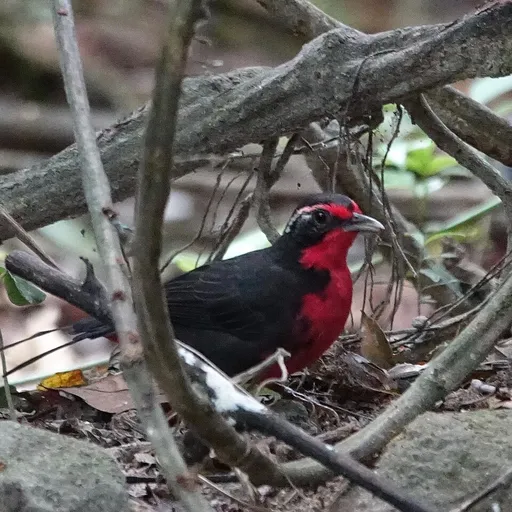
Rosy Thrush-tanager
Rhodinocichla rosea
Least Concern
Listen
XC788061 · Rosa Elena Albornoz · El Hatillo (near Caracas), El Hatillo, Miranda, Venezuela · CC0 1.0
Overview
The rosy thrush-tanager (Rhodinocichla rosea) is a bird species that forms its own family, Rhodinocichlidae. It is found in Central and South America, with populations that are highly disjunct across Mexico, Costa Rica, Panama, Colombia, and Venezuela.
Identification
- Size and Build: A slim bird measuring 19 to 21.5 cm in length, resembling a mockingbird or thrasher with a wide rounded tail and a long decurved bill.
- Plumage: Sexually dimorphic; adult males have rosy red lores, throat, and central breast, contrasting with dark gray to blackish upperparts and flanks, while females exhibit similar patterns in deeper cinnamon or tawny hues.
- Head Markings: A distinctive white supercilium extends well past the eye, separating the rosy red lores from the dark crown.
- Bill: Features a black maxilla and a pale horn-gray mandible, both of which may display varying amounts of yellow.
Habitat
This species inhabits arid to semi-arid woodlands, scrublands, and secondary forest, occasionally appearing in moister semi-deciduous woodland in Venezuela. It favours dense undergrowth where it usually remains hidden, occurring at elevations between roughly 100 and 1,800 m depending on the region.
Diet
Primarily an insectivore, the rosy thrush-tanager consumes beetles, ants, spiders, and seeds, with at least one record of it eating a frog. It forages almost entirely on the ground within dense cover, often flicking leaves aside with its bill while moving singly or in pairs.
Did you know?
The species is a year-round resident, yet its breeding seasons vary significantly by location, spanning from May to June in Venezuela to a lengthy January to September window in Costa Rica.
Sources
- Wikipedia · CC BY-SA 4.0
- Wikidata · CC0 1.0