
Ross's Gull
Rhodostethia rosea
Least Concern
Overview
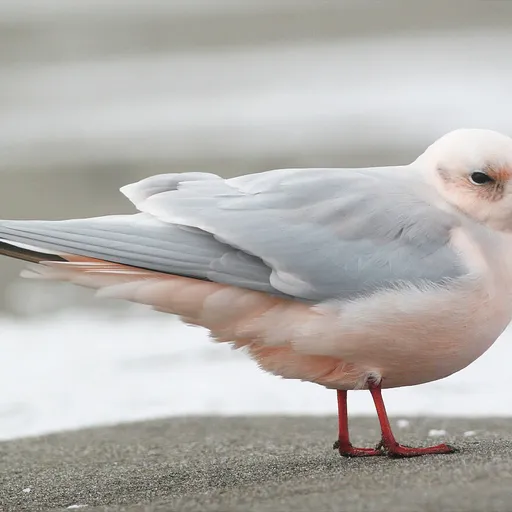
Ross's gull (Rhodostethia rosea) is a small gull and the only species in its genus. It is the smallest gull in the Northern Hemisphere, slightly larger and longer-winged than the little gull.
Identification
- Length 29–31 cm, weight 140–250 g, with pointed wings and a wedge-shaped tail.
- Summer adults are pale grey above and white below, with a pink flush to the body and a neat black neck ring.
- Winter plumage loses the neck collar, developing a small dark crescent behind the eye; pink tones may fade.
- Juveniles resemble winter adults but feature a dark 'W' pattern on the wings in flight and lack pink tones.
Habitat
Breeds in the high Arctic tundra of northernmost North America and northeast Siberia, utilising areas with sedges, grass tussocks, dwarf willows, and pools. Winters primarily at the edge of the pack ice in the northern Bering Sea and Sea of Okhotsk, with rare vagrants reaching temperate regions such as north west Europe.
Diet
Consumes small fish and crustaceans, foraging on mudflats during the winter like a wader. Is largely insectivorous during the breeding season, feeding on beetles and flies.
Did you know?
The genus name Rhodostethia is derived from the Ancient Greek words for 'rose' and 'breast', referring to the species' distinctive pink colouring. The specific name rosea is Latin for 'rose-coloured'.
Sources
- Wikipedia · CC BY-SA 4.0
- Wikidata · CC0 1.0