
Mourning Sierra Finch
Rhopospina fruticeti
Least Concern
Overview
The mourning sierra finch (Rhopospina fruticeti) is a species of bird in the family Thraupidae, found across the Andes and Patagonia in Argentina, Bolivia, Chile, and Peru. It is considered of Least Concern by the IUCN, with a stable population and no immediate threats identified.
Identification
- Stocky bird approximately 18 cm long with a long tail and medium-sized bill.
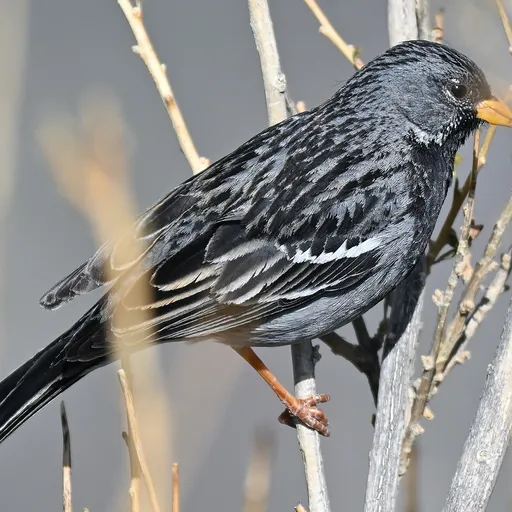
- Sexually dimorphic, with adult males featuring a mostly gray head with black streaking, blackish underparts, and white wing bars, while females are brownish-gray with pale supercilium and buffy flanks.
- Males have an orange-yellow bill and dull orange legs; females possess dull pinkish legs and feet.
- Vocalisations are described as odd-sounding, loud, mechanical, and buzzy, often accompanied by a ringing note.
Habitat
In the Andes, this species inhabits dry montane scrublands, including Polylepis forest and its edges, as well as some cultivated areas. In Patagonia, it prefers shrub-steppe, particularly areas dominated by Berberis shrubs. Its range extends from sea level up to 4,200 m, with some populations moving to lower elevations or north for winter in central Chile and far southern Argentina.
Diet
The mourning sierra finch feeds on seeds and invertebrates, foraging on the ground often near cover. During the breeding season, it forages singly, in pairs, or in small family groups, while in winter it may form flocks of up to 100 individuals or join mixed-species feeding flocks of sparrows and other finch-like tanagers.
Did you know?
The genus name Rhopospina combines the Ancient Greek rhōps meaning 'bush' with spina meaning 'finch', while the specific epithet is derived from the Latin fruticetum meaning 'thicket'. The species has been recorded as a vagrant to Brazil and the Falkland Islands, though it is primarily resident in South America.
Sources
- Wikipedia · CC BY-SA 4.0
- Wikidata · CC0 1.0