
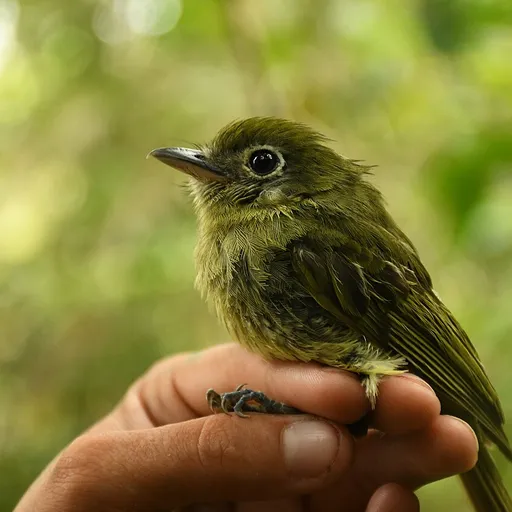
Eye-ringed Flatbill
Rhynchocyclus brevirostris
Least Concern
Overview
The eye-ringed flatbill (Rhynchocyclus brevirostris) is a species of tyrant flycatcher found in Mexico, throughout Central America, and in northwestern Colombia. Assessed as Least Concern by the IUCN, the bird has a very large range, although its population is believed to be decreasing and it is considered locally extinct in areas with intense deforestation.
Identification
- Length of 15 to 17 cm, with a large, wide, and flat bill featuring a black upper part and a pale horn-colored lower part.
- A bold white eye-ring, greyish lores and cheeks, and an olive-green head and upperparts, with a pale yellow belly and streaked breast.
- Distinctive vocalisations include a thin, buzzy, insect-like 'zweeeeeeee-zweeeee' or 'zeeeee-zeeeee-zweeeeee', as well as a high-pitched whistle described as 'sweet!'.
Habitat
This species inhabits the interior and edges of humid evergreen and semi-deciduous forests, cloud forests, and nearby secondary forests, favouring shady ravines. It occupies altitudes ranging from sea level to 2,100 m in Mexico and most of Central America, and between 600 and 1,700 m in Panama and Colombia.
Diet
It feeds primarily on a variety of arthropods, along with berries and seeds. Foraging is typically conducted singly, though the bird often joins mixed-species flocks and is known to attend army ant swarms in Costa Rica. It tends to be sluggish, peering from perches in the upper understory and capturing prey with upward sallies to snatch or hover-glean from leaves and twigs.
Did you know?
The nest is a large pear-shaped mass suspended from a twig or vine that can be placed anywhere between 1.5 and 12 m above the ground, with a tunnel entrance sloping upwards to the bottom of the cup. Adults roost inside this structure year-round, not just during the breeding season.
Sources
- Wikipedia · CC BY-SA 4.0
- Wikidata · CC0 1.0