
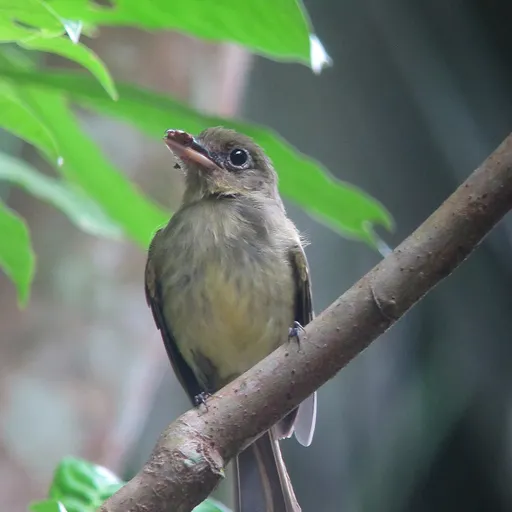
Eastern Olivaceous Flatbill
Rhynchocyclus olivaceus
Least Concern
Listen
XC249877 · Niels Krabbe · Morona-Santiago: e-slope Cord. de Cutucú: Uuntsuants, Ecuador · CC BY-SA 4.0
Overview
The eastern olivaceous flatbill (Rhynchocyclus olivaceus) is a species of tyrant flycatcher native to South America. It is classified as Least Concern on the IUCN Red List and is found in Brazil, French Guiana, Guyana, Suriname, and Venezuela.
Identification
- Approximately 15 cm long with a wide, flat bill featuring a black maxilla and pale horn mandible.
- Dark olive upperparts and head, distinguished by a white eye-ring in the nominate subspecies.
- Underparts are grayish olive on the breast with olive streaks, transitioning to pale yellow on the belly, flanks, and vent.
- Legs and feet are blue-gray to gray.
Habitat
The species inhabits humid terra firme forest, secondary woodland, and várzea forest at elevations from sea level to 500 m. It has a disjunct distribution, with different subspecies occupying northern and southern regions of the Amazon Basin as well as northeastern and eastern Brazil.
Diet
This bird feeds on arthropods, foraging singly or joining mixed-species flocks. It typically perches in the understory to capture prey in the understory or mid-story using outward or upward sallies to snatch or hover-glean food from leaves and twigs.
Did you know?
Its nest is a bulky, ragged, pear-shaped mass made from fungal rhizomorphs, plant fibers, and dead leaves, often suspended 1.6 to 3 m above the ground with a sloping tunnel entrance.
Sources
- Wikipedia · CC BY-SA 4.0
- Wikidata · CC0 1.0