
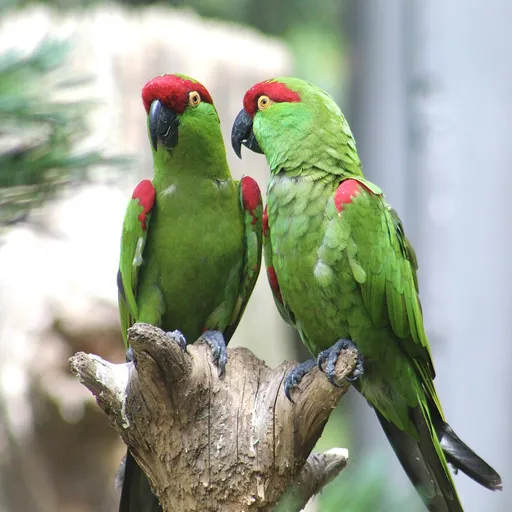
Thick-billed Parrot
Rhynchopsitta pachyrhyncha
Endangered
Overview
The thick-billed parrot (Rhynchopsitta pachyrhyncha) is a medium-sized, bright green parrot endemic to Mexico that formerly ranged into the southwestern United States. Classified as Endangered, it is sometimes referred to as the thick-billed macaw or thick-billed conure, and its position within parrot phylogeny remains a subject of ongoing discussion.
Identification
- Bright green plumage with a red forecrown, shoulders, and thighs; adults have amber eyes while juveniles have brown eyes.
- Large, heavy black bill and a black tail.
- Underwing displays red on the leading edge, followed by a blackish green stripe, a yellow stripe, and dark green on the remainder.
- Voice resembles a high-pitched macaw, producing harsh, rolling calls similar to human laughter.
Habitat
This species inhabits temperate conifer, pine, mature pine-oak, and fir forests at elevations of 1,200 to 3,600 metres. It is largely restricted to the Sierra Madre Occidental in Chihuahua and Durango, Mexico, though it previously extended its range into the southwestern United States, including Arizona, New Mexico, and Texas.
Diet
The parrot mainly feeds on seeds from various pine species, with Mexican white pine appearing as a preferred source, alongside seeds from Douglas fir, Apache pine, Chihuahua pine, and yellow pine. It is nomadic, following variations in cone abundance and breeding at the peak of pine seed production, and to a lesser extent feeds on acorns and pine buds.
Did you know?
These birds are adept fliers capable of sleeping in one mountain range and crossing vast distances to feed in another each day. They deal with deep snow by hanging upside-down and climbing on the bare underside of a snow-covered branch to access cones.
Sources
- Wikipedia · CC BY-SA 4.0
- Wikidata · CC0 1.0