
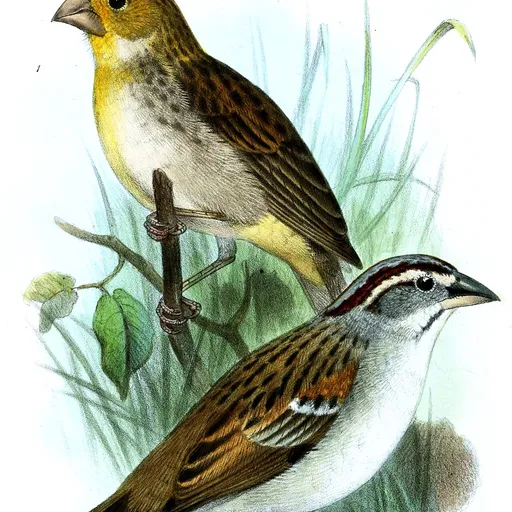
Tumbes Sparrow
Rhynchospiza stolzmanni
Least Concern
Listen
XC243044 · Niels Krabbe · Loja: 2 km SW Catamayo (La Toma), Ecuador · CC BY-SA 4.0
Overview
The Tumbes sparrow (Rhynchospiza stolzmanni) is a medium-sized bird in the family Passerellidae, endemic to the Tumbes Region of South America. It is a fairly common species currently assessed as 'least concern' by the International Union for Conservation of Nature.
Identification
- Medium-sized sparrow measuring approximately 14.5 cm in length with a broad, conical bill that is blackish on the upper mandible and horn-coloured on the lower mandible.
- Grey crown featuring a lateral chestnut stripe extending to the nape, a white superciliary stripe, and a brown eyestripe, accompanied by a dark moustachial stripe at the base of the bill.
- Greyish-brown upper parts boldly streaked with black and greyish-white underparts, with wings showing obscure barring due to chestnut-edged and tipped coverts.
- Song consists of a repeated, clear metallic note uttered up to five times ('chew-chew-chew-chew') interspersed with trills, mainly heard during the breeding season.
Habitat
Found in Ecuador and Peru, the species inhabits subtropical or tropical dry forests and dry shrubland, such as dry scrub, open dry woodland, and semi-desert with cacti and bushes. Its altitudinal range extends up to about 1,400 m.
Diet
The Tumbes sparrow feeds on seeds and insects, typically foraging on the ground. It usually occurs singly or in pairs.
Did you know?
The species' nest is a cup-shaped structure made of grasses and lined with fine material, placed in a concealed position among grasses on the ground. Breeding coincides with the rainy season and takes place from January to May.
Sources
- Wikipedia · CC BY-SA 4.0
- Wikidata · CC0 1.0