
Knobbed Hornbill
Rhyticeros cassidix
Vulnerable
Overview
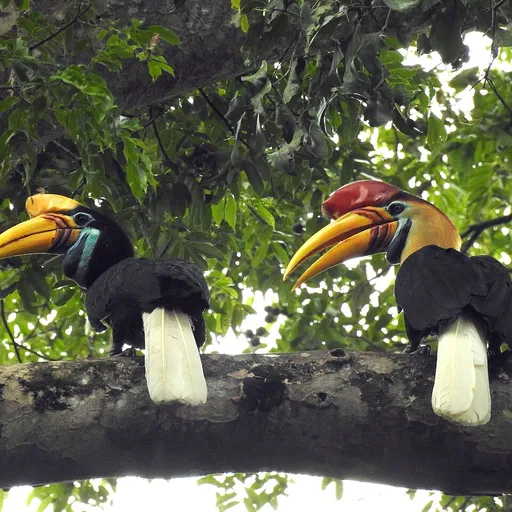
The knobbed hornbill (Rhyticeros cassidix), also known as the Sulawesi wrinkled hornbill, is a large, colourful bird native to Indonesia. It serves as the faunal symbol of South Sulawesi province and is currently classified as Vulnerable on the IUCN Red List.
Identification
- Large black body with white tail feathers, blackish feet, and bare dark blue throat.
- Yellow bill topped by a high red casque in males and a yellow casque in females.
- Males feature rufous/buff faces and necks with orange-red eyes, while females have black faces and necks with brownish eyes.
- Pale blue skin surrounds the eye in both sexes.
Habitat
An Indonesian endemic, this species is found on Sulawesi, Buton, Lembeh, Togian, and Muna Island. It primarily inhabits evergreen forests at elevations up to 1,800 m, though it also utilises secondary forest, woodland, and plantations for foraging.
Diet
The diet consists mainly of fruits, supplemented by insects and small vertebrates. As important seed dispersers, these birds influence the initial fate of seeds for several tropical forest tree species within their habitat.
Did you know?
The breeding season spans 27–30 weeks and is triggered by a dramatic reduction in rainfall. During this period, the female seals herself inside a tree hole using her own faeces, relying on the male to provide food through a narrow slit.
Sources
- Wikipedia · CC BY-SA 4.0
- Wikidata · CC0 1.0