
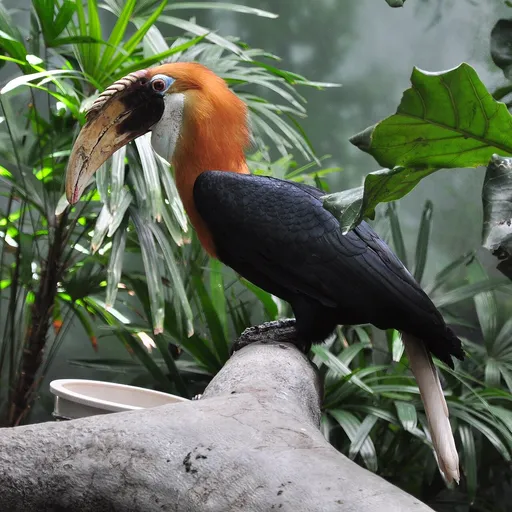
Blyth's Hornbill
Rhyticeros plicatus
Least Concern
Overview
Blyth's hornbill, also known as the Papuan hornbill, is a large hornbill inhabiting the forest canopy in Wallacea and Melanesia. It is the only hornbill species native to New Guinea and one of the largest flying birds in the region.
Identification
- Up to 91 cm in length, with adult males featuring mainly black plumage, a golden or orange-buff head, white throat, and white tail.
- Females are smaller, mainly black with a white throat and tail, while young birds of both sexes resemble the male.
- Both sexes possess a very large horn-coloured bill and casque, with adult casques displaying up to eight folds depending on age.
- In flight, it produces a loud, rushing wing noise compared to steam escaping from a locomotive, accompanied by far-reaching, guttural grunting and laughing calls.
Habitat
Found throughout lowland forests from sea level up to 1,200–1,500 m ASL in the Moluccas, New Guinea, the Bismarck Archipelago, and as far east as the Solomon Islands. It is assessed as Least Concern on the IUCN Red List, though hunting pressure affects populations in some areas of New Guinea.
Diet
The diet consists mainly of fruits, especially figs, occasionally supplemented with insects and other small animals. Females are largely sealed inside tree hollows during nesting and are fed by the male through a narrow aperture.
Did you know?
During the breeding season, the female is sealed inside a nest cavity with a mixture of fruit pulp and rotten wood, leaving only a narrow aperture for the male to feed her.
Sources
- Wikipedia · CC BY-SA 4.0
- Wikidata · CC0 1.0