
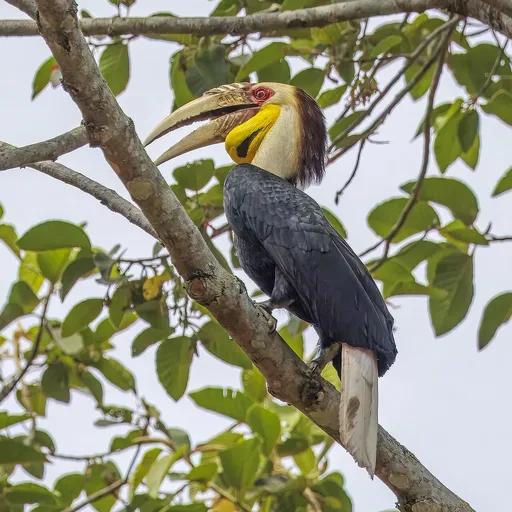
Wreathed Hornbill
Rhyticeros undulatus
Vulnerable
Overview
The wreathed hornbill (Rhyticeros undulatus) is an Old World tropical bird of the hornbill family Bucerotidae, distinguished by the ridges or 'wreaths' on its casque. It is currently listed as Vulnerable on the IUCN Red List due to threats including hunting and habitat loss.
Identification
- Males feature a rufous crown, white upper breast and face, and a yellow featherless throat, while females are uniformly black with a blue throat.
- A medium-sized bird measuring 75 to 90 cm in length, with a pale yellow bill that has distinctive serrated ridges near the base.
- Characterised by a loud double yelp described as 'coo-cuk' or 'wuff-wurff', often accompanied by a sharp thrust of the head backwards to display the throat sac.
Habitat
Found across the foothills and evergreen forests of Northeast India, Bhutan, Bangladesh, Southeast Asia, and the Greater Sunda Islands, with a maximum recorded elevation of 2,560 m. During the breeding season it resides in lowland areas but moves to higher elevations during the non-breeding season.
Diet
Primarily a frugivore that feeds on large fruits, particularly figs, using a technique called ballistic food transport to swallow items whole. It occasionally consumes small animals such as insects, crabs, snails, and reptiles, especially during the breeding season.
Did you know?
The bird's distinctive casque contains foamy air-filled cavities surrounded by keratin tiles, which is hypothesised to function as a vocal enhancement tool, a physical weapon, and a visual cue for age and social status.
Sources
- Wikipedia · CC BY-SA 4.0
- Wikidata · CC0 1.0