
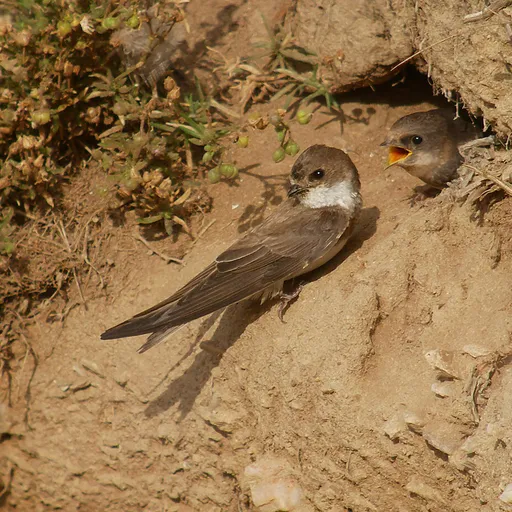
Sand Martin
Riparia riparia
Least Concern
Listen
XC707135 · Sonothèque ADVL · Saint-Jean-le-Thomas, Manche, Normandie, France · CC0 1.0
Overview
The sand martin (Riparia riparia), also known as the bank swallow, is a migratory passerine bird in the swallow family Hirundinidae. It has a wide range in summer, embracing practically the whole Holarctic area, and winters in eastern and southern Africa, southern Asia, and South America.
Identification
- Brown upperparts with white underparts and a narrow brown band across the breast.
- Black bill and brown legs.
- Small size, measuring 12–13 cm in length with a wingspan of 26.5–29 cm.
- Distinctive continuous gravelly twittering when in flight, which becomes a conversational undertone at roosts, alongside a harsh alarm call.
Habitat
Sand martins are generally found near larger bodies of water, such as rivers, lakes, or the ocean, throughout the year. They breed in winding tunnels bored into sand or gravel banks, with a preference for loess soil. In Britain, they are the first of their family to arrive on breeding grounds, typically in mid-March.
Diet
Their food consists of small insects, mostly gnats and other flies whose early stages are aquatic. They forage by flitting over larger bodies of water to catch these early flies.
Did you know?
In Canada, the sand martin is listed as Threatened under Schedule 1 of the federal Species at Risk Act due to the loss of 98% of its Canadian population over the past 40 years.
Sources
- Wikipedia · CC BY-SA 4.0
- Wikidata · CC0 1.0