
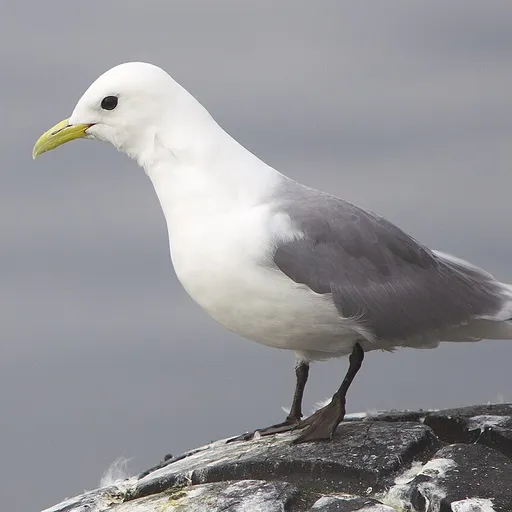
Black-legged Kittiwake
Rissa tridactyla
Vulnerable
Listen
XC1143440 · Sonothèque ADVL · Fréhel, Cotes-d'Armor, Brittany, France · CC0 1.0
Overview
The black-legged kittiwake (Rissa tridactyla) is a seabird in the gull family Laridae, currently classified as Vulnerable on the IUCN Red List. It is the most pelagic of the gulls, spending the majority of its time at sea and on the wing, away from the coast, except during the breeding season when it nests on cliffs. In Europe, it is often referred to simply as the kittiwake, while in North America it is distinguished from the red-legged kittiwake.
Identification
- 37–41 cm in length with a white head and body, grey back, and wings tipped solid black.
- Distinguished by black legs and a yellow bill, contrasting with the red legs of the red-legged kittiwake.
- Possesses only three toes, as the hind toe is extremely reduced or absent in the Atlantic subspecies.
- Acquires a dark grey smudge behind the eye and a grey hind-neck collar in winter, with the bill turning dusky-olive.
- Produces a distinctive call resembling a shrill 'kittee-wa-aaake'.
Habitat
A coastal bird found in the Arctic to subarctic regions of the North Atlantic and North Pacific oceans, ranging from Canada to Greenland and Alaska to Siberia. It is almost exclusively pelagic, rarely seen inland, though vagrants occasionally turn up far from the sea. During the breeding period from May to September, it nests on the sheerest sea cliffs.
Diet
Primarily a pelagic piscivore, feeding mainly on fish such as capelin, herring, and sandeels, though it also consumes invertebrates like copepods and squid when fish are scarce. It forages at the surface by hovering and head-diving, often following whales to catch expelled fish fragments or scavenging scraps from commercial fishing boats.
Did you know?
Chicks exhibit siblicide, where the first-born chick may kill its sibling within the first ten days of life to avoid competition for food. The species is also notable for its ability to utilise vertical cliffs for nesting, with some populations recently shifting to urban structures like street lights and bridges in cities such as Newcastle and Tromsø.
Sources
- Wikipedia · CC BY-SA 4.0
- Wikidata · CC0 1.0