
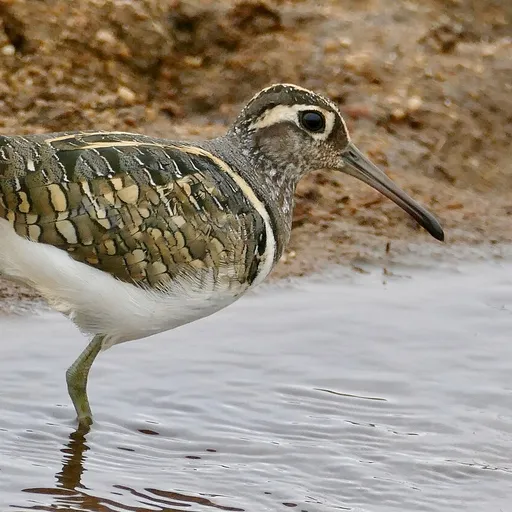
Greater Painted-snipe
Rostratula benghalensis
Least Concern
Overview
The greater painted-snipe is a medium-sized wader widely distributed across Africa and southern Asia. This sexually dimorphic species is characterised by the female being larger and more brightly coloured than the male, and by the unusual social structure where females mate with multiple males who subsequently incubate the eggs and raise the young.
Identification
- Size: Medium-sized with an overall length of 23–28 cm.
- Female: Features a black head with a buff stripe, white eye-patch, and dark rufous neck; upperparts are dark bronze-green finely barred with black, and the underbody is white.
- Male: Much paler and less uniform than the female, with barring on the scapulars and wing-coverts.
- Juvenile: Resembles the male but lacks the darker band around the chest.
Habitat
This species inhabits a variety of wetland environments including swamps, marshes, and the edges of lakes, rivers, ponds, and streams. It prefers muddy areas with available vegetation cover and is typically found near the fringes of reed beds. The bird is widely distributed across mainland Africa, Madagascar, the Seychelles, India, and Southeast Asia, though it is notably absent from the desert areas of Namibia, the eastern portion of Somalia, and parts of Botswana and South Africa.
Diet
The greater painted-snipe feeds on insects, snails, earthworms, crustacea, and vegetable matter such as plant seeds. It forages by using a scythe-like action of the head and bill in shallow water. The species is generally crepuscular, feeding primarily in the early morning and near dusk.
Did you know?
The species exhibits polyandry, where the female initiates courtship and mates with multiple males, typically two but up to four per season. Consequently, the males are responsible for incubating the eggs for around 19 days and providing parental care for the precocial young.
Sources
- Wikipedia · CC BY-SA 4.0
- Wikidata · CC0 1.0