
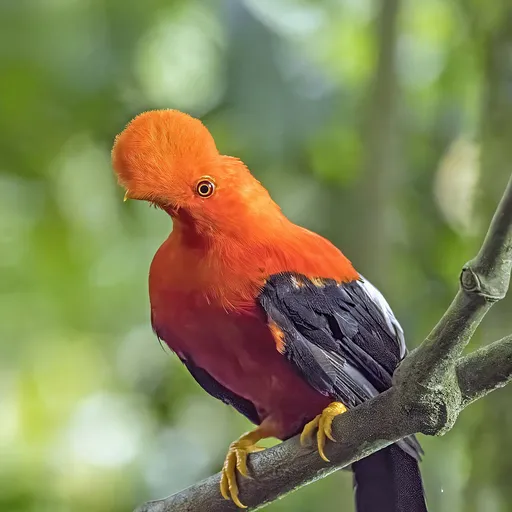
Andean Cock-of-the-rock
Rupicola peruvianus
Least Concern
Listen
XC248871 · Niels Krabbe · Napo: 'Cabañas San Isidro', 1-2 km SW Cosanga, Ecuador · CC BY-SA 4.0
Overview
The Andean cock-of-the-rock, also known as tunki in Quechua, is a large passerine bird native to the Andean cloud forests of South America. It is the national bird of Peru and belongs to the cotinga family, with its closest relative being the Guianan cock-of-the-rock.
Identification
- A large passerine approximately 32 cm long, with males featuring a prominent disk-like crest and brilliant scarlet or orange plumage.
- Males have black tails and wings, while females are significantly darker, browner, and possess a less prominent crest.
- The bill is yellowish in males but dark with a small yellow tip in females, and the bird may emit a loud querulous "tank?" call when disturbed or in flight.
Habitat
This species inhabits the cloud forests of the Andes, with a range spanning approximately 260,000 km2 across Venezuela, Colombia, Ecuador, Peru, and Bolivia. It predominantly occupies ravines and forested streams in montane areas at elevations between 500 and 2,400 m, typically staying in the lower and middle forest levels.
Diet
The diet consists mainly of fruit and insects, supplemented by amphibians, reptiles, and smaller mice. They frequently feed on fruits from the Lauraceae, Annonaceae, and Rubiaceae plant families and are known to follow army ants for food.
Did you know?
Females construct their nests using a mixture of their own saliva, vegetable matter, and mud, plastering these concave cup-shaped structures onto cave entrances or rocky outcrops in forest ravines.
Sources
- Wikipedia · CC BY-SA 4.0
- Wikidata · CC0 1.0