
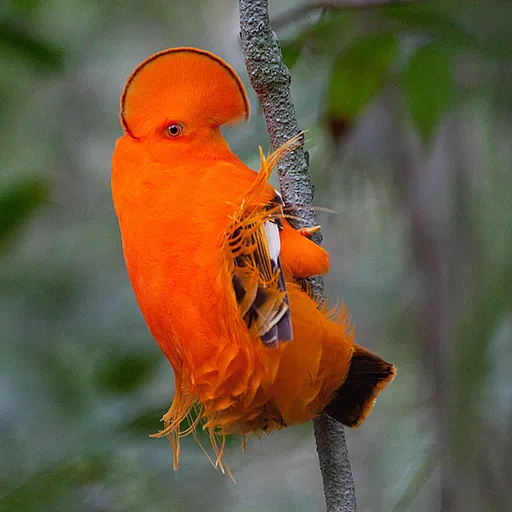
Guianan Cock-of-the-rock
Rupicola rupicola
Least Concern
Overview
The Guianan cock-of-the-rock (Rupicola rupicola) is a species of cotinga and passerine bird native to South America. It is a sexually dimorphic, stout-bodied bird known for its remarkable half-moon crest and distinct plumage differences between sexes. Listed as Least Concern on the IUCN Red List, the species is considered fairly common with a stable population within its range.
Identification
- Size and build: Approximately 30 cm (12 in) in length, weighing 200 to 220 g (7.1 to 7.8 oz), with a heavy, stout body and a broad-based bill.
- Plumage: Males are bright orange with an orange-tipped black tail, black, orange, and white wings, and silky-orange filamentous feathers; females are dark brownish-grey and less conspicuous.
- Head and features: Both sexes possess a prominent half-moon crest, with the male's crest being more pronounced; males have a bright orange bill, while females have a yellow-tipped black bill.
- Legs and eyes: Both sexes have orange legs and skin; males have an orange iris that yellows towards the outer edge, whereas females have a duller orange iris.
Habitat
The Guianan cock-of-the-rock inhabits humid tropical rainforests across the Guianan Shield, including French Guiana, Suriname, Guyana, southern Venezuela, eastern Colombia, and northern Amazonian Brazil. It is typically found at altitudes between 300 and 2,000 m, strongly preferring areas near rocky outcrops where it nests on vertical rock faces and cliffs.
Diet
The species is primarily frugivorous, with its diet consisting mainly of fruit from canopy trees and lianas, up to 65 different species of which have been recorded. It occasionally feeds on small snakes, lizards, insects, and frogs, and plays an ecological role in forest regeneration by defecating or regurgitating seeds near leks.
Did you know?
Females choose a mate by flying down to the ground and pecking the male on his rump, after which he turns around for mating to occur almost immediately. Males also display the highest rate of homosexual behaviour among birds, with almost 40 percent engaging in such activity.
Sources
- Wikipedia · CC BY-SA 4.0
- Wikidata · CC0 1.0