
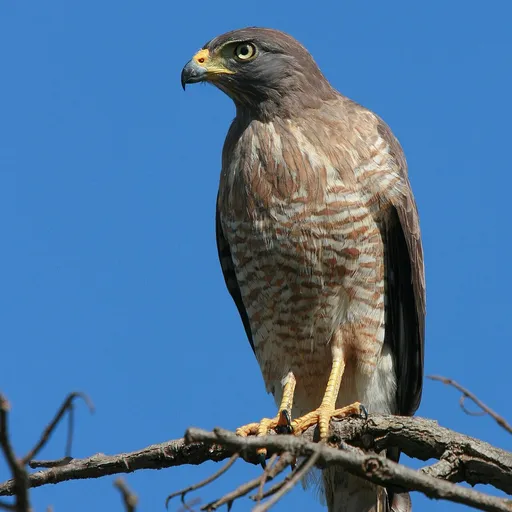
Roadside Hawk
Rupornis magnirostris
Least Concern
Listen
XC806726 · Flávio C.T. Lima · Campinas, Campinas, São Paulo, Brazil · CC0 1.0
Overview
The roadside hawk (Rupornis magnirostris) is a relatively small bird of prey found throughout the Americas, often recognised as the most common raptor in its range. It is currently placed in the monotypic genus Rupornis, having previously been classified within Buteo, and is listed as Least Concern on the IUCN Red List.
Identification
- Length of 31–41 cm and weight of 250–300 g, with males approximately 20% smaller than females.
- Plumage varies by subspecies, generally brown or grey, with barred brown and white underparts and tails featuring four or five grey bars; a touch of rufous may appear on the wings.
- Adults have whitish or yellow eyes and a relatively large beak, as suggested by the species name magnirostris.
- In flight, the bird displays a relatively long tail and disproportionately short wings; it frequently soars but does not hover.
- The call is a very high-pitched, piercing squeak.
Habitat
The roadside hawk is common from Mexico through Central America to most of South America east of the Andes, extending south to northeastern Argentina. It is well adapted to most ecosystems in its range, including urban areas, where it may be the most conspicuous hawk species, though it possibly avoids dense rainforests. Vagrants are occasionally recorded in Texas, United States.
Diet
The diet consists mainly of insects, squamates, and small mammals, such as young common marmosets and similar small monkeys, with small birds taken less frequently. The species regularly hunts using the 'still hunting' method, patiently waiting on a perch before dropping or gliding down to capture prey. It is encountered in mixed-species feeding flocks in open cerrado habitat, where it is considered a less significant threat than smaller raptors like the American kestrel.
Did you know?
The genus name Rupornis derives from the Ancient Greek words rhupos, meaning 'dirt' or 'filth', and ornis, meaning 'bird'. The species is sometimes perceived as the most common hawk in cities, a reputation possibly amplified by its aggressive defensive behaviour towards humans near the nest.
Sources
- Wikipedia · CC BY-SA 4.0
- Wikidata · CC0 1.0