
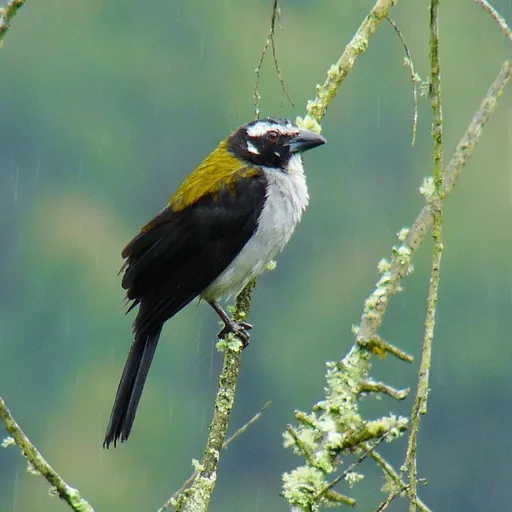
Black-winged Saltator
Saltator atripennis
Least Concern
Listen
XC243048 · Niels Krabbe · Esmeraldas: 7 km WNW Lita, Ecuador · CC BY-SA 4.0
Overview
The black-winged saltator, Saltator atripennis, is a songbird in the family Thraupidae. It is a year-round resident found in the Andes of Colombia and Ecuador, assessed as Least Concern by the IUCN.
Identification
- Approximately 20.5 cm long with a thick, blackish bill and gray or brown legs.
- Nominate adults feature a mostly black head with a long, wide white supercilium and a small white patch at the rear of the ear coverts, while S. a. caniceps has a mostly gray crown.
- Upperparts are bright olive-green with dull black wings and tail that often show faint greenish edges on the tertials and greater coverts.
- Song is characterised by a distinctive leisurely pace, including phrases such as 'twee', 'twaa', or 'toower'.
Habitat
Inhabits the canopy and edges of humid to wet primary and mature secondary forests, as well as shrubby clearings and plantations, in the Andes of Colombia and Ecuador. In Colombia it occupies elevations between 600 and 2,300 m, while in Ecuador it is mostly found below 1,500 m.
Diet
The diet is believed to be mostly fruit, though it has not been specifically studied. Foraging occurs in the upper levels of the forest, frequently as part of mixed-species feeding flocks.
Did you know?
The nest is a deep cup constructed with an outer structure of roots, moss, and leaves, lined with grasses and fine plant fibers, holding a clutch of two or three blue or greenish eggs marked with brownish-black patterns.
Sources
- Wikipedia · CC BY-SA 4.0
- Wikidata · CC0 1.0