
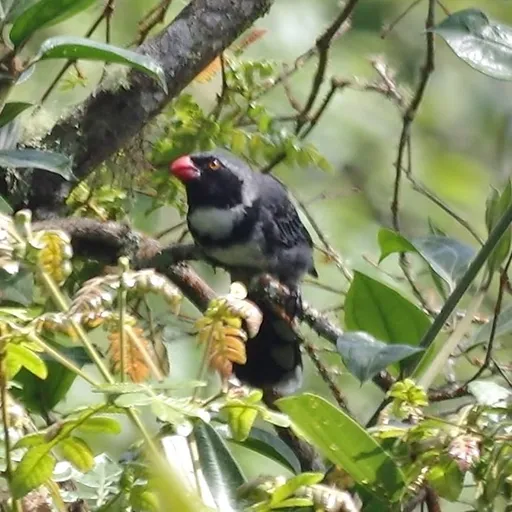
Masked Saltator
Saltator cinctus
Least Concern
Overview
The masked saltator (Saltator cinctus) is a passerine bird in the family Thraupidae, native to Colombia, Ecuador, and Peru. Although currently assessed as Least Concern by the IUCN, its estimated population of 30,000 mature individuals is believed to be declining due to habitat loss.
Identification
- Plumage: Adults feature a slate-gray crown and upperparts, a black face and throat bordered by a white line, and underparts that are mostly white with a black breast band, gray flanks, and wide black barring on the vents.
- Size: The Ecuadoran and Peruvian population measures 21.5 cm in length, while the Colombian population is slightly smaller at 20 cm.
- Features: Possesses an orange or golden iris with a red inner ring, a bill that is mostly red with a mixed black and red mandible, and slate-gray legs and feet.
- Song: Produces a melodic 'chu-chu-chu-chuwit?' song, accompanied by calls described as 'tzip', 'tseeyk', or a soft 'tiu-tiu'.
Habitat
This species inhabits Podocarpus forest in Colombia at elevations between 2,000 and 3,000 m, and humid montane forest in the subtropical and lower temperate zones of Ecuador and Peru. The Ecuadoran range extends between 2,000 and 2,700 m, while the Peruvian range spans 1,700 to 3,000 m.
Diet
The masked saltator feeds on fruits and seeds, foraging predominantly in the canopy. Single birds and pairs occasionally join mixed-species feeding flocks, and the species may move nominally in response to the abundance of fruiting trees.
Did you know?
The Colombian population of the masked saltator is distinct from other groups, featuring a minimal pale streak behind the face, a creamy white belly, a red eye, and an entirely red bill.
Sources
- Wikipedia · CC BY-SA 4.0
- Wikidata · CC0 1.0