
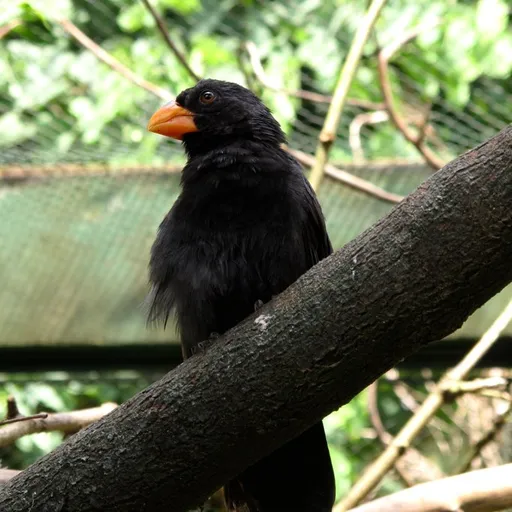
Black-throated Grosbeak
Saltator fuliginosus
Least Concern
Overview
The black-throated grosbeak (Saltator fuliginosus) is a species of bird in the family Thraupidae, the tanagers and allies. It is found in Argentina, Brazil, and Paraguay.
Identification
- Adults range from 20 cm to 22 cm in length, with males being deep slate-blue and females appearing duller with less blue.
- Males possess black lores, face, ear coverts, throat, and upper breast, with black wings edged in slate-blue and a uniformly black tail.
- Both sexes feature a dark brown iris, a bright coral-red bill, and dark gray legs and feet.
- The song is often two-parted with a long interval, described as "Weétju-pjerur thur -wur wír", where 'Weét' and 'wír' carry the highest pitch.
Habitat
The species inhabits the humid Atlantic Forest and maintains a disjunct distribution across southeastern Brazil, northeastern Argentina, and parts of Brazil's northeast and south-central regions. It is considered a year-round resident in its range, though records from Paraguay have not been confirmed since the early twentieth century.
Diet
The specific diet of the black-throated grosbeak has not been studied, but the bird typically forages from the forest's mid-story up to the canopy.
Did you know?
The shiny cowbird (Molothrus bonariensis) acts as a brood parasite on this species, though details regarding the grosbeak's nest, incubation period, and parental care remain unknown.
Sources
- Wikipedia · CC BY-SA 4.0
- Wikidata · CC0 1.0