
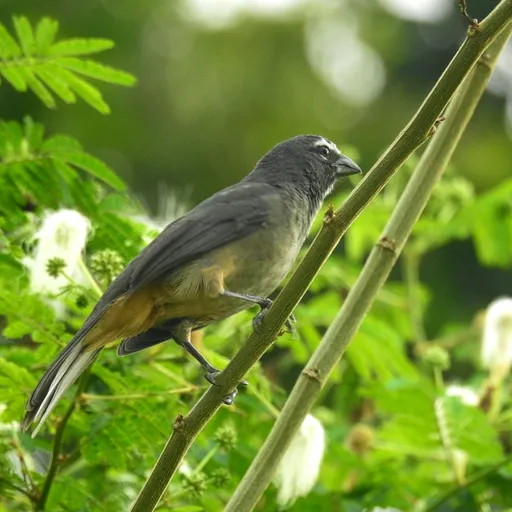
Cinnamon-bellied Saltator
Saltator grandis
Least Concern
Listen
XC613387 · Diego_Barrales · Apomos, San Ignacio Municipality, Sinaloa, Mexico · CC BY 4.0
Overview
The cinnamon-bellied saltator (Saltator grandis) is a passerine bird in the family Thraupidae, the tanagers and allies. It is found from Mexico to Panama.
Identification
- Males and females share the same plumage, with adults displaying a deep brownish-grey head and a wide white supercilium extending beyond the eye.
- The breast, sides, and flanks are greyish or greyish olive with a strong buffy tinge on the flanks, while the belly, vent, and undertail coverts are a deep buff or cinnamon buff.
- The bird measures 22 to 24 cm (8.7 to 9.4 in) in length and weighs between 50 and 60 g (1.8 to 2.1 oz), featuring a blackish bill and blackish to leaden-grey legs and feet.
- Its song is described as a pleasant whistled phrase, often noted as a 3- or 4-part series ending in a long clear upslurring whistle, "teeut-peeur-weeeeeeeet!".
Habitat
The species inhabits a wide variety of landscapes, ranging from drier, semideciduous or deciduous vegetation to humid evergreen habitats. It is usually found along forest edges, watercourses, and in open habitats such as plantations, gardens, and urban parks. Its elevation range generally extends from sea level to 1,500 m (4,900 ft).
Diet
The cinnamon-bellied saltator feeds on fruits, other plant material such as flowers and nectar, and insects. It forages singly or in small groups and sometimes joins mixed-species feeding flocks, operating at all levels of its habitat.
Did you know?
The bird's eggs in Mexico and Costa Rica are bright blue with black markings. It breeds between April and August, constructing a large cup nest from twigs and leaves that is well-concealed in a shrub or tree between 1.5 and 4 m above the ground.
Sources
- Wikipedia · CC BY-SA 4.0
- Wikidata · CC0 1.0