
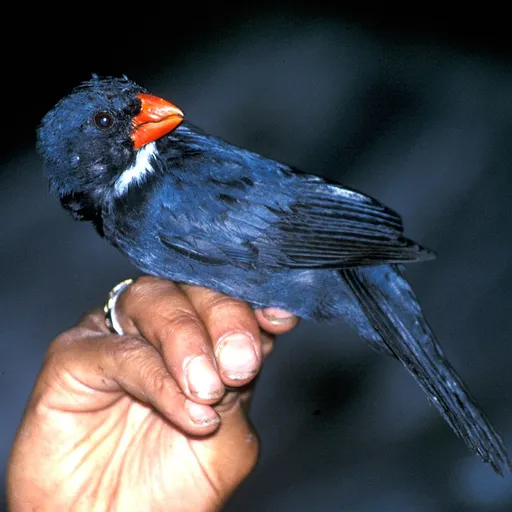
Slate-colored Grosbeak
Saltator grossus
Least Concern
Listen
XC242984 · Niels Krabbe · Napo: 1 km S Puerto Napo, Ecuador · CC BY-SA 4.0
Overview
The slate-colored grosbeak (Saltator grossus) is a species of bird in the family Thraupidae, found from Honduras to Panama and across most mainland South American countries except Argentina, Chile, Paraguay, and Uruguay. It is a year-round resident that inhabits the interior and edges of humid forests and mature secondary forests.
Identification
- 19 to 20.5 cm long and weighing 41 to 53 g, with a bright orange-red or red bill and dark horn to black legs.
- Males are mostly slaty blue with black lores, face, and upper breast, while females are duller with greenish slate underparts and no black on the face or throat.
- Song consists of sweet, rich musical whistles described as "pwit-seeur-seeur-see'ehh" or a mellow warble like "chewee chewee-whew".
- Calls include a nasal, whining "eeeiirrr" or a descending, mewing "reeeehr" with a metallic tchip.
Habitat
The species inhabits the interior and edges of humid forest and mature secondary forest, occurring in both terra firme and várzea forest in the Amazon Basin. Its range covers a disjunct distribution, with the northern subspecies found on Caribbean and Pacific slopes from Honduras to Ecuador, and the nominate subspecies found in the Amazon Basin and Guiana Shield from Colombia to Brazil.
Diet
Although its diet has not been extensively studied, it is known to include seeds and insects. The bird forages from the mid-level to the canopy of the forest, usually in pairs, and sometimes joins mixed-species feeding flocks.
Did you know?
The slate-colored grosbeak is a sister species to the black-throated grosbeak, and some authors consider them a superspecies despite being treated as distinct species. They are distinguished in the field by the black-throated grosbeak having more black on the face and a black throat.
Sources
- Wikipedia · CC BY-SA 4.0
- Wikidata · CC0 1.0