
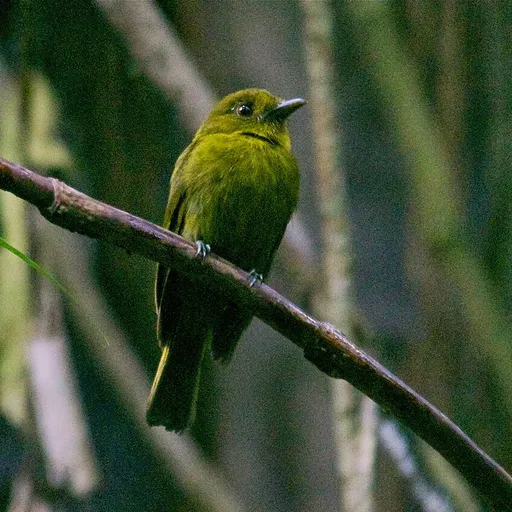
Sapayoa
Sapayoa aenigma
Least Concern
Listen
XC248302 · Niels Krabbe · Esmeraldas: right bank Rio Santiago, above Estero Pote 7 km E Playa de Oro, Ecuador · CC BY-SA 4.0
Overview
The sapayoa or broad-billed sapayoa (Sapayoa aenigma) is a suboscine passerine bird found in Colombia, Ecuador, and Panama. It is classified as a monotypic genus within its own family, Sapayoidae, and is assessed as Least Concern on the IUCN Red List, although its population size is unknown and believed to be decreasing.
Identification
- Measures 13.5 to 15 cm in length and weighs approximately 21 g, with a wide, black bill surrounded by rictal bristles.
- Head and upperparts are olive with a dusky tinge to the wings and tail, while the throat and belly are a yellower olive.
- Males possess a yellow stripe on the crown, and the species has dull reddish-brown irises with gray legs.
- Vocalizations include a soft trill and a slightly louder 'chipp, ch-ch-ch'.
Habitat
The sapayoa inhabits humid forests from the understory to the mid-level, often occurring in ravines and near watercourses. Its range extends from the Panama Canal Zone south through western Colombia into extreme northwestern Ecuador, reaching elevations of up to 1,200 m in Colombia but only 500 m in Ecuador.
Diet
It feeds by perching for long periods between sallies to catch insects on the wing or from foliage, and also consumes small fruits. The sapayoa often joins mixed-species feeding flocks.
Did you know?
Despite being found in the Americas, the sapayoa is an Old World suboscine that is hypothesized to have ancestors that reached South America via the Western Antarctica Peninsula when Gondwana was splitting apart.
Sources
- Wikipedia · CC BY-SA 4.0
- Wikidata · CC0 1.0