
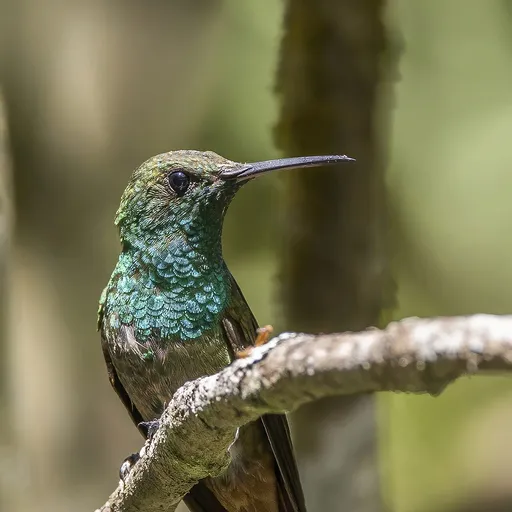
Berylline Hummingbird
Saucerottia beryllina
Overview
The berylline hummingbird (Saucerottia beryllina) is a species of hummingbird found in arid landscapes across El Salvador, Guatemala, Honduras, Mexico, and the southern United States. Formerly placed in the genus Amazilia, it was moved to the resurrected genus Saucerottia following a 2014 molecular phylogenetic study.
Identification
- Length ranges from 8 to 10 cm, with males weighing approximately 4.4 g and females around 4.0 g.
- Adult males of the nominate subspecies feature a bronze-green to coppery head, back, and rump, with coppery to rufous tail and chestnut bases on the primaries visible as a patch on the closed wing.
- Underparts are glittering golden green in males, while females have paler, more greyish throats and bellies.
- Song consists of slightly gruff, high-pitched twittering notes described as 'ssi kirr-i-rr' or 'sirrr, ki-ti ki-dik', accompanied by hard, buzzy calls like 'dzzzzir'.
Habitat
This species primarily inhabits arid landscapes, including dense oak and pine-oak forests, scrublands, deciduous and thorn forests, and human-modified areas such as plantations and gardens. It ranges in elevation from near sea level to the submontane zone, though it is most common between 500 and 1,800 m.
Diet
A generalist feeder, the berylline hummingbird forages for nectar from a wide variety of native and introduced flowering plants at all forest levels. It also captures arthropods by hawking from a perch or picking them from spider webs, often dominating other hummingbird species at flowering trees.
Did you know?
The bird constructs a solid cup nest using grass and other plant fibers bound together with spiderweb and decorated with lichens on the outside, typically placed on a horizontal branch up to 15 m above the ground.