
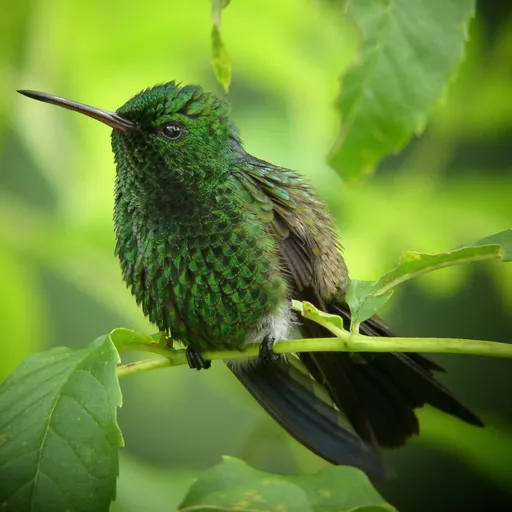
Copper-rumped Hummingbird
Saucerottia tobaci
Least Concern
Listen
XC1146769 · Rosa Elena Albornoz @rosaelena_naturaleza · San Antonio De Los Altos (near Parroquia Macarao), Los Salias, Miranda, Venezuela · CC0 1.0
Overview
The copper-rumped hummingbird (Saucerottia tobaci) is a small species of hummingbird within the tribe Trochilini of subfamily Trochilinae. It is native to the Caribbean and northern South America, found in Tobago, Trinidad, and Venezuela. The species is currently assessed as Least Concern on the IUCN Red List, with a large range and no immediate threats identified.
Identification
- Length 9 to 11 cm, with males weighing 4.6 to 4.7 g and females 3.5 to 4.2 g.
- Both sexes possess a straight, medium-length, blackish bill featuring a pinkish base to the mandible.
- Males of the nominate subspecies display bronze-green upperparts with purple-red uppertail coverts, dark golden-green underparts, and reddish brown undertail coverts.
- Song consists of a repeated phrase of three buzzy or squeaky, well-spaced notes described as 'tee-dee-dew' or 'tee-dzee-djit', along with high-pitched descending rattles when foraging.
Habitat
This species inhabits a wide variety of forest types, including gallery forest, cloudforest, rainforest, and secondary forest, with some island subspecies also found in savanna, plantations, and gardens. Most subspecies range from sea level to 1,000 m, though some reach elevations of 2,000 m. It is found in Tobago, Trinidad, and various regions of Venezuela, with its presence in Grenada considered doubtful.
Diet
The copper-rumped hummingbird forages for nectar from at least 40 species of trees, vines, herbs, and other plants. It is extremely territorial, vigorously defending feeding areas from other birds, even larger ones. In addition to nectar, it feeds on small insects by hawking from a perch or gleaning from vegetation.
Did you know?
Nests are constructed from silky plant down with lichen on the outside and are often placed like a saddle in a fork or on a small branch, though they have also been found on wires and clotheslines. The female incubates two eggs for 16 to 19 days, with up to three broods potentially produced each season.
Sources
- Wikipedia · CC BY-SA 4.0
- Wikidata · CC0 1.0