
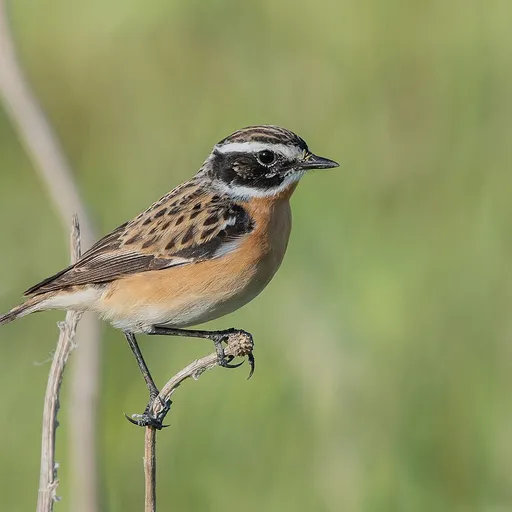
Whinchat
Saxicola rubetra
Least Concern
Listen
XC1156737 · Petr Holecek · PR Černá louka, Teplice District, Ústí nad Labem Region, Czech Republic · CC0 1.0
Overview
The whinchat (Saxicola rubetra) is a small migratory passerine bird that breeds in Europe and western Asia and winters in central Africa. It is a solitary species that belongs to the Old World flycatcher family, Muscicapidae, and is currently classified as a species of 'least concern' by the International Union for Conservation of Nature.
Identification
- Similar in size to a European robin, measuring 12 to 14 cm in length and weighing between 13 and 26 g.
- Features brownish upperparts mottled darker, a pale buff to whitish belly, and a blackish tail with white bases to the outer feathers.
- Males in breeding plumage display a blackish face mask encircled by a strong white supercilium and a bright orange-buff throat, while females are duller with browner markings.
- Possesses a whistling, crackly but soft song during the breeding season that often mimics at least 12 other bird species, and a main call described as 'hue-tac-tac'.
Habitat
Breeds across Europe and western Asia from Ireland to the Ob River basin and from northern Norway to central Spain and the Caucasus Mountains. Favors open grassy country with rough vegetation and scattered small shrubs, such as hawthorn, bracken, or heather, and requires perching points like shrubs or fence posts. Winters primarily in tropical sub-Saharan Africa, though small numbers also winter in northwestern Africa.
Diet
Insectivorous birds that consume roughly 80–90% insects, along with a wide range of other invertebrates such as spiders, small snails, and worms. They occasionally eat small amounts of fruit, such as blackberries, primarily in autumn. They forage by perching on elevated spots and making sallies to catch insects, mostly taken from the ground but also flying insects.
Did you know?
The whinchat's song is highly mimetic, incorporating phrases from the songs of at least 12 other assorted bird species. Males also frequently flick their tails and wings while perched to display white flashes, which serves as a territorial communication signal to other whinchats.
Sources
- Wikipedia · CC BY-SA 4.0
- Wikidata · CC0 1.0