
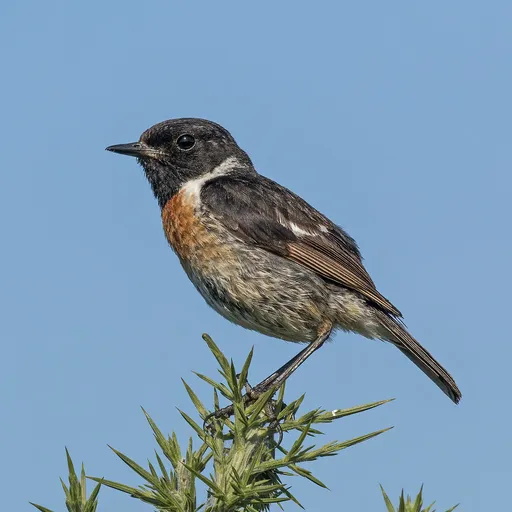
European Stonechat
Saxicola rubicola
Listen
XC730773 · Sonothèque ADVL · Le Val-Saint-Père, Manche, Normandie, France · CC0 1.0
Overview
The European stonechat (Saxicola rubicola) is a small passerine bird now classified in the Old World flycatcher family, Muscicapidae. It inhabits parts of Europe, North Africa, and the Middle East, having been separated from the common stonechat as a distinct species based on genetic evidence.
Identification
- Males in summer plumage display black upperparts and heads with an orange throat and breast, contrasting with a white belly and distinct white half-collar on the neck.
- Females feature brown upperparts and heads, with streaked dark brown underparts on a paler background, lacking the white neck and rump patches of the male.
- The bird is approximately 11.5–13 cm long and weighs between 13–17 g, making it slightly smaller than the European robin.
- Its call is distinctive, resembling the sound of two stones knocking together, while the male's song is high and twittering.
Habitat
This species breeds in heathland, coastal dunes, and rough grassland characterised by scattered small shrubs, brambles, open gorse, tussocks, or heather. Its range extends across Europe to Ukraine and the South Caucasus, with populations wintering in North Africa and the Middle East, though some individuals remain non-migratory.
Did you know?
The common name 'stonechat' is derived directly from the bird's calling sound, which mimics the noise of two stones being knocked together.