
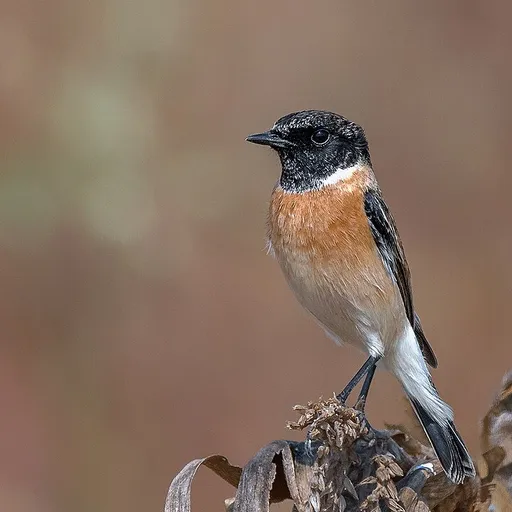
Amur Stonechat
Saxicola stejnegeri
Overview
The Amur stonechat (Saxicola stejnegeri) is a subspecies of the Siberian stonechat that has sometimes been considered a distinct species based on molecular genetic studies. It belongs to the Old World flycatcher family Muscicapidae and was formerly placed in the thrush family Turdidae. The specific epithet stejnegeri honours the American ornithologist Robert新field Stejneger.
Identification
- Male breeding plumage: Black upperparts and head with a conspicuous white collar, scapular patch, and rump, along with a restricted area of orange on the throat.
- Female: Pale brown upperparts and head, white neck patches (not a full collar), and a pale, unstreaked pinkish-yellow rump.
- Winter male: Intermediate between breeding males and females, featuring a supercilium resembling the whinchat but distinguished by the full white collar.
- Bill: Not explicitly described, but it has an insectivorous diet and forages on the ground.
- Legs: Not explicitly described, but typical for stonechats, likely short and strong for hopping on the ground.
- Markings: White rump and whiter underparts with less orange on the breast compared to the European stonechat.
Habitat
It breeds in open rough scrubland or rough grassland with scattered shrubs, from sea level to about 4,000 m ASL or more. The birds seem to avoid cool temperate conditions and stay up north only during the hot continental summer. Migrants can on occasion be seen foraging in fields and pastures more than 2,000 m ASL in the Himalayan foothills of Bhutan.
Diet
The Siberian stonechat is insectivorous. It forages on the ground in open rough scrubland or rough grassland with scattered shrubs. In the Himalayan foothills of Bhutan, migrants can on occasion be seen foraging in fields and pastures.
Did you know?
The Amur stonechat is the easternmost subspecies of the Siberian stonechat and has been separated based on molecular genetic studies. It breeds in eastern Siberia to Japan and Korea and winters in southern China and Indochina.