
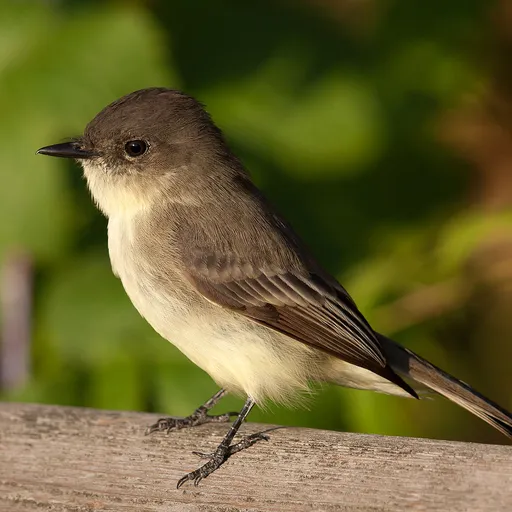
Eastern Phoebe
Sayornis phoebe
Least Concern
Listen
XC1109345 · Doug Hynes · Big Glace Bay Lake National Wildlife Area, Nova Scotia, Canada · CC BY-SA 4.0
Overview
The eastern phoebe (Sayornis phoebe) is a small passerine bird that is highly adaptable to urban environments. It is categorised on the IUCN Red List as Least Concern. The name 'phoebe' may reference the Roman moon goddess Diana or imitate the bird's distinctive call.
Identification
- Length of 5.5–6.7 in (14–17 cm) with a wingspan of 10.2–11.0 in (26–28 cm) and a weight of 0.6–0.7 oz (16–21 g).
- Gray-brown plumage above with a white throat, dirty gray breast, and buffish underparts that whiten during the breeding season.
- An all-dark bill and the absence of an eye ring or wingbars distinguish it from other North American tyrant flycatchers.
- A sharp chip call and a song sounding like fee-bee, often accompanied by pumping the tail up and down while perched.
Habitat
Eastern phoebes breed in eastern North America, excluding the southeastern coastal United States, favouring open woodland, farmland, and suburbs, often near water. They are highly adaptable to urban settings and frequently nest on human structures such as bridges and buildings. Outside the breeding season, they winter in the southernmost United States and Central America.
Diet
The eastern phoebe is primarily insectivorous, consuming a majority of its summer diet in insects such as small wasps, bees, beetles, flies, true bugs, and grasshoppers. It also eats spiders, ticks, and millipedes. During cooler months, it frequently consumes small fruits and berries.
Did you know?
The eastern phoebe is a very rare vagrant to western Europe. It is one of the first birds to return to breeding grounds in spring and one of the last to leave in fall, with migration times remaining unchanged over the last century.
Sources
- Wikipedia · CC BY-SA 4.0
- Wikidata · CC0 1.0