
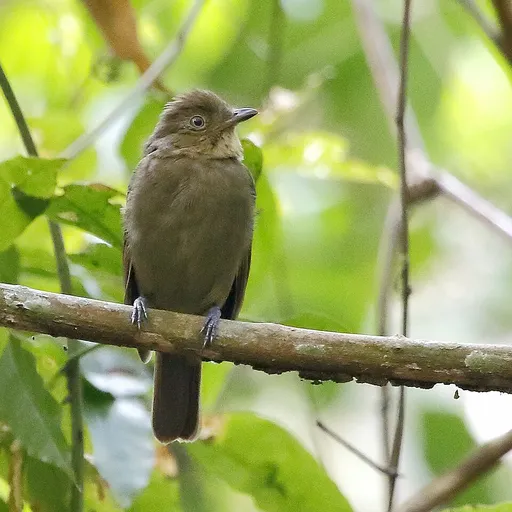
Brown-winged Schiffornis
Schiffornis turdina
Least Concern
Listen
XC248988 · Niels Krabbe · Orellana: 'Maxus' road km 37 (27 km SSE Pompeya), Ecuador · CC BY-SA 4.0
Overview
The brown-winged schiffornis, also known as the brown-winged mourner (Schiffornis turdina), is a species of Neotropical bird within the family Tityridae. It is classified as Least Concern by the IUCN and is considered sedentary, found across parts of South America including Bolivia, Brazil, Colombia, Ecuador, Peru, and Venezuela.
Identification
- Measures 15.5 to 16.5 cm in length and weighs between 22 and 38 g, with males and females sharing identical plumage.
- Possesses dull brownish olive upperparts and tail, wings with rufescent feather edges, a lighter brownish olive-gray breast, and pale olive-gray belly and vent.
- Features an indistinct pale ring around the eye on a brownish olive face, a blackish bill, and olive grayish legs and feet.
- Song consists of a variable sequence of 2–4 clear, rich musical whistles, with the last one sharply upslurred, alongside a short rattling chatter.
Habitat
This species inhabits primarily the interior of humid forests, though it occasionally appears at forest edges, in secondary growth, or in drier forests. Its range is disjunct across South America, reaching elevations up to 800 m in Venezuela, 300 m in Ecuador, 1,500 m in Peru, and 1,000 m in Brazil.
Diet
The brown-winged schiffornis feeds on fruits and insects, though specific dietary details are lacking. It typically forages singly in the forest understory, often clinging to low-level vertical stems and taking food from vegetation with short sallies from a perch, while rarely joining mixed-species feeding flocks.
Did you know?
The only known nest of this species was constructed from plant fibers and dry leaves within a partially rotted tree stump. This nest contained two pale yellowish-white eggs marked with a few blackish spots, although incubation and fledging details remain unknown.
Sources
- Wikipedia · CC BY-SA 4.0
- Wikidata · CC0 1.0