
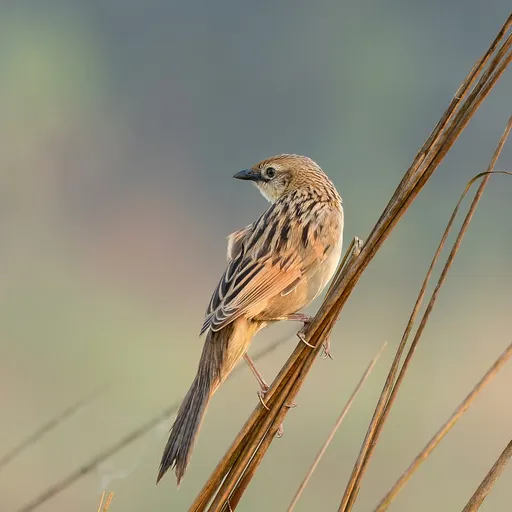
Bristled Grassbird
Schoenicola striatus
Vulnerable
Overview
The bristled grassbird (Schoenicola striatus) is a small passerine bird endemic to the Indian subcontinent, where it is patchily distributed across Bangladesh, India, Nepal, and Pakistan. Currently classified as Vulnerable by the IUCN Red List, this species is threatened by the destruction of its preferred grassland and marshland habitats.
Identification
- Large and brownish plumage with broad dark streaks on the crown and back, resembling a common babbler, featuring a buff supercilium and a pale unmarked underside.
- Strong, black bill with the lower mandible tipped bluish grey, and brown tarsus.
- Distinctive bare skin patch in front of the eyes from which a vertical row of five stiff rictal bristles arise, believed to act as a protective visor.
- Flight calls consist of a rising and falling 'chwee-chew' sound.
Habitat
This species inhabits dense and tall grass-covered marshlands, primarily in the northern part of the Indian subcontinent. It was formerly thought to be sedentary but may now be migratory, breeding in riverine plains south of the Himalayas and wintering further south and east in the Indian peninsula.
Diet
Bristled grassbirds are insectivorous, foraging by skulking within dense grass clumps to capture insect prey. They are rarely seen, usually only briefly at the top of a grass clump before diving back down to remain hidden.
Did you know?
The bird possesses a flexible patch of bare skin in front of its eyes that folds back to form a kind of cage or visor, protecting the eye as the bird scampers through rough grass. This protective visor is supported by five stiff rictal bristles that face forward.
Sources
- Wikipedia · CC BY-SA 4.0
- Wikidata · CC0 1.0