
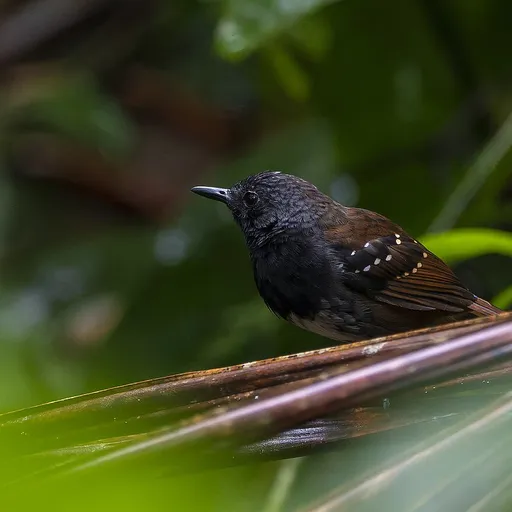
Northern Chestnut-tailed Antbird
Sciaphylax castanea
Least Concern
Listen
XC251212 · Niels Krabbe · Zamora-Chinchipe: above 'Cabañas Yankuam' 2 km S Las Orchideas, Nangaritza Valley, Ecuador · CC BY-SA 4.0
Overview
The northern chestnut-tailed antbird, also known as Zimmer's antbird, is a small bird in the family of typical antbirds. It is a year-round resident found in the understoreys of terra firme forests in South America.
Identification
- Males of the nominate subspecies have a mostly gray head with black feather centres, brownish-gray hindcrown and upper mantle, and dark yellowish red-brown upperparts, tail and flight feathers.
- They feature a white patch between the scapulars with black spots, black wing coverts with large white to buff-white tips, and black throat and upper breast.
- Females are paler, with reddish yellow-brown underparts and a white belly.
- Both sexes possess a black bill.
Habitat
The species primarily inhabits the understorey and floor of terra firme forests, almost exclusively in somewhat stunted forest growing on nutrient-poor sandy soils. Its elevation range is between 125 and 1,000 m in Colombia, up to 1,350 m in Peru, and generally below 350 m in Ecuador, though locally reaching 1,450 m.
Diet
The diet of the northern chestnut-tailed antbird has not been detailed, but it is assumed to feed on insects and other arthropods. It forages as single birds, pairs or family groups, usually on the ground or within about 1 m of it, rarely joining mixed-species feeding flocks or attending army ant swarms.
Did you know?
The bird's song is a slow but accelerating, rising series of loud whistled notes that can occasionally drop in pitch on the last note or two.
Sources
- Wikipedia · CC BY-SA 4.0
- Wikidata · CC0 1.0