
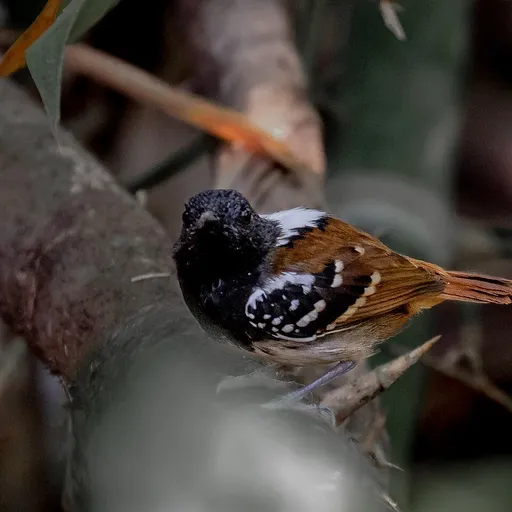
Southern Chestnut-tailed Antbird
Sciaphylax hemimelaena
Least Concern
Overview
The Sciaphylax hemimelaena, commonly known as the southern chestnut-tailed antbird, is a passerine bird within the family Thamnophilidae. It is classified as a species of Least Concern on the IUCN Red List, indicating a stable population and large range.
Identification
- Males of the nominate subspecies feature a grey head and upper mantle with black feather centres, while their tail and flight feathers are dark yellowish red-brown.
- A distinctive white patch with black spots near the feather tips appears between the scapulars, and wing coverts are black with large white or buff-white tips.
- Females differ by having a brown tinge on the crown, a reddish yellow-brown throat and breast, and a pale mandible.
- The male's song consists of a slow but accelerating descending series of loud, chiming notes often ending in a quiet churred phrase.
Habitat
Found in eastern Peru, southwestern Amazonian Brazil, and northwestern Bolivia, the species primarily inhabits the understorey and floor of terra firme forest and nearby mature secondary forest. In Peru, it also occurs in seasonally flooded forests, while in parts of Brazil it is associated with bamboo and herbaceous plants in gaps caused by fallen trees.
Diet
This bird feeds on a variety of insects, probably including spiders and other arthropods. It forages mainly on the ground or within about 1.5 m of it, typically clambling among fallen branches and hopping or flutter-flying between tangles. It occasionally joins mixed-species feeding flocks and may briefly attend army ant swarms.
Did you know?
Only two nests of the southern chestnut-tailed antbird have ever been documented, both found in Bolivia. These open cups, constructed from palm leaves, dead leaves, and rootlets, are hung in vegetation very near the ground.
Sources
- Wikipedia · CC BY-SA 4.0
- Wikidata · CC0 1.0