
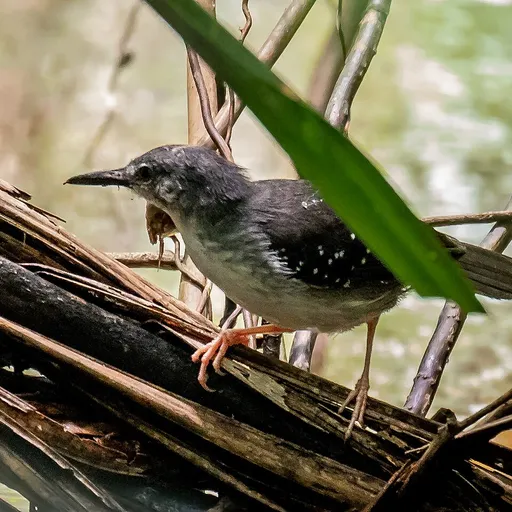
Silvered Antbird
Sclateria naevia
Least Concern
Listen
XC249442 · Niels Krabbe · Napo: 1 km S Puerto Napo, Ecuador · CC BY-SA 4.0
Overview
The silvered antbird (Sclateria naevia) is a passerine bird in the subfamily Thamnophilinae of the family Thamnophilidae, known as the 'typical antbirds'. It is the sole member of the genus Sclateria and is assessed as being of Least Concern by the IUCN.
Identification
- Adults are 14 to 16 cm long, with males featuring dark grey upperparts and white underparts with grey scalloping.
- Females share the male pattern but are greyish brown, while subadult males resemble adult females.
- The song is described as a long, rapid trill of abrupt notes that rises in pitch and intensity before dropping off steeply.
Habitat
Found in Trinidad and every mainland South American country except Argentina, Chile, Paraguay, and Uruguay, this species inhabits the floor and understorey of tropical evergreen forest, particularly várzea and igapó along streams and swampy areas. It favours locations with vine tangles and vegetation overhanging water's edges, reaching elevations of up to 600 m in Peru.
Diet
The silvered antbird feeds primarily on insects and spiders, foraging as individuals, pairs, or small family groups within about 1 m of the ground. It picks prey from leaf litter, reaches up to leaves and twigs, and occasionally picks prey from the water's surface while perched above it.
Did you know?
Its nesting habits involve weaving an open cup of thick rootlets and moss into low branches that overhang water, which may be an adaptation to its frequent presence in flood-prone environments.
Sources
- Wikipedia · CC BY-SA 4.0
- Wikidata · CC0 1.0