
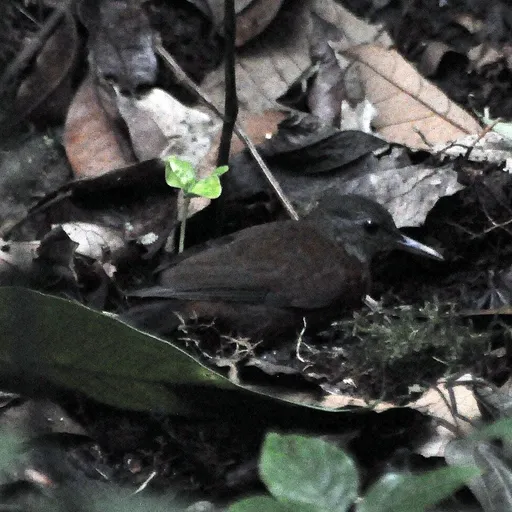
Grey-throated Leaftosser
Sclerurus albigularis
Least Concern
Listen
XC249833 · Niels Krabbe · Morona-Santiago: w-slope Cord. de Cutucú, Ecuador · CC BY-SA 4.0
Overview
The grey-throated leaftosser (Sclerurus albigularis) is a Near Threatened species of bird in the ovenbird family Furnariidae. It inhabits evergreen forests across parts of Central and South America, where it remains a year-round resident.
Identification
- One of the larger members of the genus Sclerurus, measuring 16 to 18 cm in length and weighing 34 to 46 g, with sexes that are alike in appearance.
- The nominate subspecies features a grayish brown face with a scaly texture, rich chestnut-brown crown and back, and a brighter reddish chestnut rump and uppertail coverts.
- The throat is grayish white with a darker lower edge, while the breast is dark rufous with pale streaks, and the belly is dark brown.
- Song is described as a series of four to six tripled rising notes, 'kwu-kwu-kwe-kwe-kwi-kwi', sometimes ending in musical trills, and an alarm call that is a squeaky, sharp 'cheek' or 'chik-chik'.
Habitat
The species inhabits evergreen forest, usually in foothills and lower montane areas, though its elevation range varies by region from near sea level to 2,200 m. It has a disjunct distribution across Bolivia, Brazil, Colombia, Costa Rica, Ecuador, Panama, Peru, Trinidad and Tobago, and Venezuela.
Diet
Foraging occurs mostly on the ground by flipping aside leaves, probing, and gleaning from leaf litter while hopping, typically in singles or pairs. Documented diet components include beetles, spiders, cockroaches, and tiny frogs, though the species' full diet has not been detailed.
Did you know?
The bird nests by constructing a cup of leaves inside a chamber at the end of a burrow and is believed to be monogamous. It is overall considered rare to locally uncommon, yet it is locally fairly common in Venezuela.
Sources
- Wikipedia · CC BY-SA 4.0
- Wikidata · CC0 1.0