
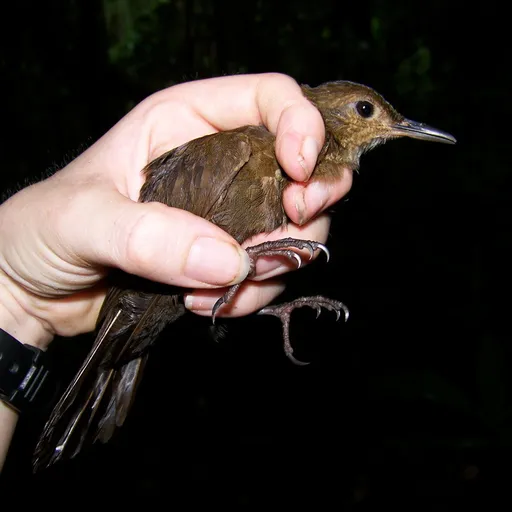
Black-tailed Leaftosser
Sclerurus caudacutus
Least Concern
Listen
XC248825 · Niels Krabbe · Orellana: s-bank Río Napo: between Añangu and Laguna Añangu, Ecuador · CC BY-SA 4.0
Overview
The black-tailed leaftosser, Sclerurus caudacutus, is a species of bird in the subfamily Sclerurinae within the ovenbird family Furnariidae. It is classified as Least Concern by the IUCN, with a very large range across South America, although its population is believed to be decreasing.
Identification
- The darkest and dullest member of the genus Sclerurus, measuring 16 to 18 cm in length and weighing 34 to 42 g.
- Features a dark rufescent face and breast, blackish brown underparts, and a sooty blackish tail, with a long, straight bill that is black to blackish brown above and bicolored below.
- Its song consists of 10–12 loud, ringing, descending 'kweet' or 'whee' notes, often preceded by a low sputtering trill, while its call is a sharp 'skweeup'.
Habitat
Found across Bolivia, Brazil, Colombia, Ecuador, French Guiana, Guyana, Peru, Suriname, and Venezuela, this bird inhabits lowland tropical terra firme evergreen forest. It ranges from near sea level up to 1,100 m in Brazil and Venezuela, and up to 950 m in Ecuador, though it is most commonly found below 500 m.
Diet
Foraging mostly on the ground by hopping rather than walking, it flips aside leaves and probes the leaf litter for invertebrates. Its diet includes cockroach eggs, beetles, ants, and annelid worms, with a single record of it feeding on fallen fruit.
Did you know?
The bird constructs its nest inside a burrow, typically excavated in an earthen bank, finishing it with a cup of leaves at the end of the chamber.
Sources
- Wikipedia · CC BY-SA 4.0
- Wikidata · CC0 1.0