
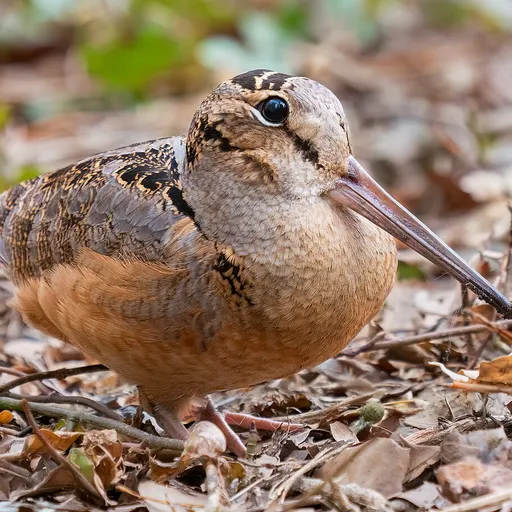
American Woodcock
Scolopax minor
Least Concern
Listen
XC544586 · Justin Watts · Richardson Nature Center, Hennepin, Minnesota, United States · CC BY-SA 4.0
Overview
The American woodcock (Scolopax minor), colloquially known as the timberdoodle, is a small shorebird species found primarily in the eastern half of North America. It is the only species of woodcock inhabiting the continent and, despite being classified with sandpipers, lives mainly in upland settings rather than coastal marshes.
Identification
- Plump body with short legs, a large rounded head, and a long, straight, prehensile bill measuring 2.5 to 2.8 inches.
- Cryptic plumage featuring a mottled mix of browns, grays, and black with chest and sides varying from yellowish-white to rich tans.
- Large eyes located high in the head, providing a visual field of 360° in the horizontal plane and 180° in the vertical plane.
- Distinctive short, buzzy ground call known as a "peent" or "meep," often followed by a high, spiralling courtship flight.
Habitat
Found in forested and mixed forest-agricultural-urban areas east of the 98th meridian, ranging from Atlantic Canada to the Gulf Coast and Mexico. The species prefers early successional habitats, abandoned farmland, and brushy swamps, with breeding ranges extending as far north as York Factory, Manitoba. Winter concentrations are highest in the northern half of Alabama, with core areas including Louisiana, Mississippi, and Georgia.
Diet
Forages primarily in moist soil by probing for invertebrates, with a preference for earthworms. The bird uses a unique bone-and-muscle arrangement to open the tip of its upper bill while it is sunk in the ground to grasp slippery prey. Other dietary items include insect larvae, snails, centipedes, spiders, snipe flies, beetles, ants, and a small amount of plant seeds.
Did you know?
The American woodcock holds the record for the slowest flight speed ever recorded for a bird, measured at just 5 mph during migration. It also possesses the largest visual field of any bird, capable of seeing 360 degrees horizontally and 180 degrees vertically.
Sources
- Wikipedia · CC BY-SA 4.0
- Wikidata · CC0 1.0