
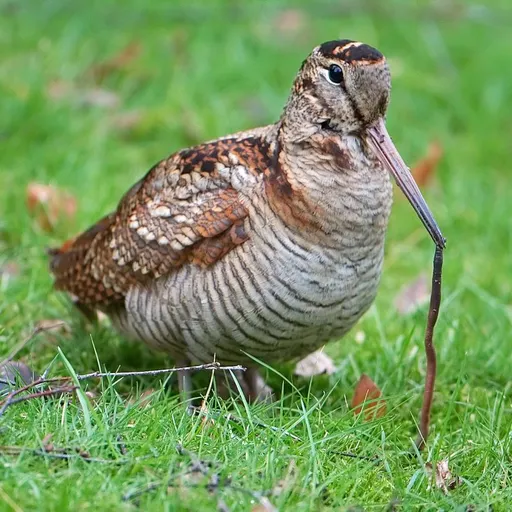
Eurasian Woodcock
Scolopax rusticola
Least Concern
Listen
XC803891 · Grégoire Chauvot · Leksand, Leksand Municipality, Dalarna County, Sweden · CC0 1.0
Overview
The Eurasian woodcock (Scolopax rusticola) is a medium-small wading bird found in temperate and subarctic Eurasia. It is a solitary, crepuscular species that relies on cryptic camouflage to thrive in woodland habitats across a vast range.
Identification
- Adults measure 33–38 cm in length with a wingspan of 55–65 cm, featuring a 6–8 cm long, straight bill.
- Plumage consists of intricately patterned reddish-brown upperparts and buff underparts for cryptic camouflage.
- The head is barred with black rather than striped, and it possesses large eyes located high on the sides of the head for 360-degree vision.
- Legs vary in colour from grey to pinkish, and the base of the bill is flesh-coloured with a dark tip.
Habitat
Breeding habitats consist of large, unfragmented broadleaved or mixed forests with dense undergrowth and clearings for flight, extending from Fennoscandia to the Mediterranean and Russia. Northern and Asian populations migrate to southern Europe or the Indian subcontinent, while birds in milder western Europe and Atlantic islands remain resident. In winter, the species also utilises scrubland and intertidal mud during freezing weather.
Diet
The species forages in soft soil within thickets, primarily feeding on earthworms but also consuming insects, their larvae, freshwater molluscs, and some plant seeds. They probe the ground with their long, sensitive bills, a method that leaves them vulnerable during cold winters when the ground is frozen. Nocturnal feeding often occurs in frost-free pasture or long-rotation grass meadows near woodland roosts.
Did you know?
It is widely believed, though only supported by anecdotal evidence, that female woodcock can carry chicks between their legs, bodies, tails, or claws whilst flying when threatened. The English surname 'Woodcock' also developed as a nickname for the bird, historically meaning 'a fool, simpleton or dupe'.
Sources
- Wikipedia · CC BY-SA 4.0
- Wikidata · CC0 1.0