
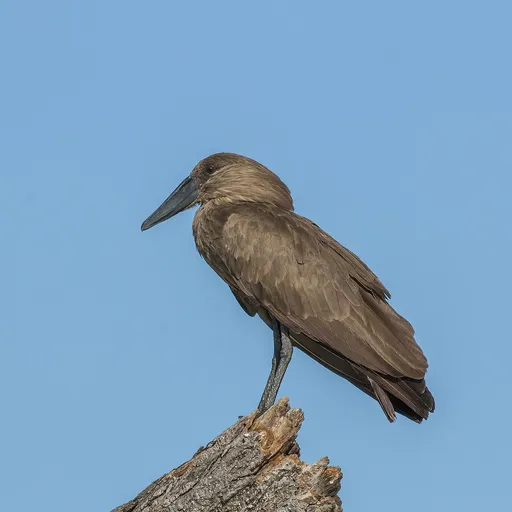
Hamerkop
Scopus umbretta
Least Concern
Overview
The hamerkop, also known as the umbrette, is a medium-sized waterbird found across mainland Africa, Madagascar, and parts of Arabia. It is the only living member of its family, Scopidae, and is currently considered to be of least concern by the IUCN.
Identification
- Medium-sized bird standing 56 cm high with drab brown plumage that shows purple iridescence on the back.
- Features a long, slightly hooked bill that is black in adults and brown in young birds, alongside a distinctive crest at the back of the head.
- Legs are black with partial feathering and partially webbed feet; the gait is jerky and rapid, with the head and neck moving back and forth.
- When alone, it makes a shrill 'nyip' or 'kek' flight call, but in groups it produces cackles, nasal rattles, and a social 'yip-purr' sound.
Habitat
Found in all wetland habitats including rivers, estuaries, marshes, mangroves, and rocky coasts, as well as human-created areas like fish ponds and villages. The species prefers shallow water for foraging and is tolerant of human presence, often nesting in trees over water or on artificial structures like walls and dams.
Diet
A generalist feeder that primarily consumes fish, amphibians, shrimp, insects, and rodents, usually foraging in shallow water by sight or by probing with its bill. It also hunts in flight by skimming the water surface with its feet and opportunistically feeds on prey flushed by grazing cattle or escaping from banded mongooses.
Did you know?
Hamerkop nests are so sturdy that they can support the weight of an adult human, and pairs compulsively build multiple nests each year that are often adorned with random items such as bones, hide, and human waste.
Sources
- Wikipedia · CC BY-SA 4.0
- Wikidata · CC0 1.0