
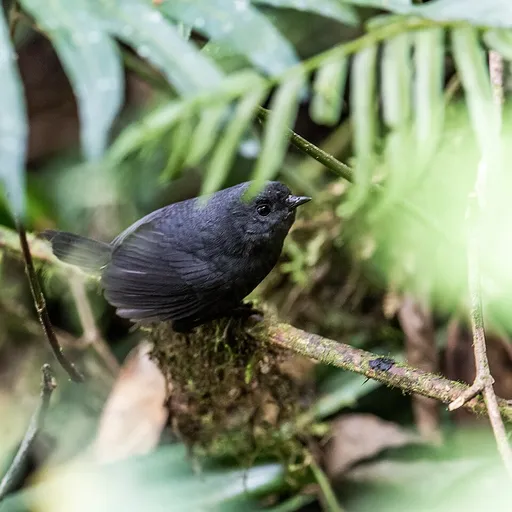
Trilling Tapaculo
Scytalopus parvirostris
Least Concern
Overview
The trilling tapaculo (Scytalopus parvirostris) is a small bird in the family Rhinocryptidae, native to the east slope of the Andes in Bolivia and Peru. It is classified as Least Concern on the IUCN Red List.
Identification
- Males are typically dark grey above and lighter grey below, sometimes dark grey all over, with dark reddish-brown, dusky-barred flanks and crissum.
- Females are paler than males with a dark brown wash, while juveniles resemble females but have a scaly appearance due to yellowish feather edges.
- The species is 10.5 cm long, with males weighing 17.5–21 g and females 15.4–18 g.
- Its song, which gives the species its name, consists of a trill that varies in pace geographically, ranging from 14 notes per second in southern Peru to 28 in Bolivia.
Habitat
It inhabits the undergrowth of humid montane forest on the east slope of the Andes, from southern Amazonas in Peru to western Santa Cruz in Bolivia. Elevations range from 1,800 to 2,500 m in Peru and 2,000 to 3,200 m in Bolivia, occasionally reaching 3,300 m.
Diet
It forages in dense undergrowth alone or in pairs, on or near the ground, though its specific diet has not been studied.
Did you know?
A 2009 study in Peru revealed that the bird constructs a globe-shaped nest of small rootlets and fern scales inside the cavity of a rotten tree, with a clutch size of two eggs.
Sources
- Wikipedia · CC BY-SA 4.0
- Wikidata · CC0 1.0