
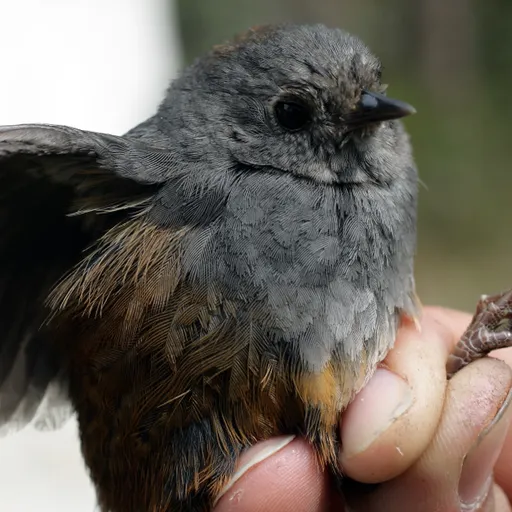
Perija Tapaculo
Scytalopus perijanus
Near Threatened
Overview
The Perijá tapaculo (Scytalopus perijanus) is a small passerine bird endemic to the Serranía del Perijá mountain range on the Colombia–Venezuela border. First formally described in 2015 based on museum specimens, the species is currently classified as Near Threatened by the IUCN Red List.
Identification
- Body length of 10 to 12 cm with a short tail of approximately 4 cm.
- Neutral grey head, brown neck, and brown-sepia striped back contrasting with grey-white underparts and tawny flanks.
- Males exhibit paler buff markings on the breast and less distinct brown spots on the nape compared to females.
- Song consists of two short churrs repeated up to 65 times at intervals of 0.5 to 3 seconds.
Habitat
Found at altitudes between 1,600 and 3,225 m in humid rainforests, elfin forests, and woody páramo shrubs within high-mountain grasslands. The species is restricted to the Serranía del Perijá, with its range partially protected by the Chamicero de Perijá Bird Reserve in Colombia and Sierra de Perijá National Park in Venezuela.
Diet
Dietary habits are poorly understood, but examination of stomach contents indicates that the Perijá tapaculo feeds exclusively on insects. Observations suggest it forages in dense thickets close to the ground and runs among bushes in open grassy areas.
Did you know?
The species was first lured by a biologist playing a recording of its own song in 2008, leading to its formal description in 2015. It builds globular nests within underground cavities approximately 14.5 cm high, accessed via a short tunnel 10 cm deep.
Sources
- Wikipedia · CC BY-SA 4.0
- Wikidata · CC0 1.0