
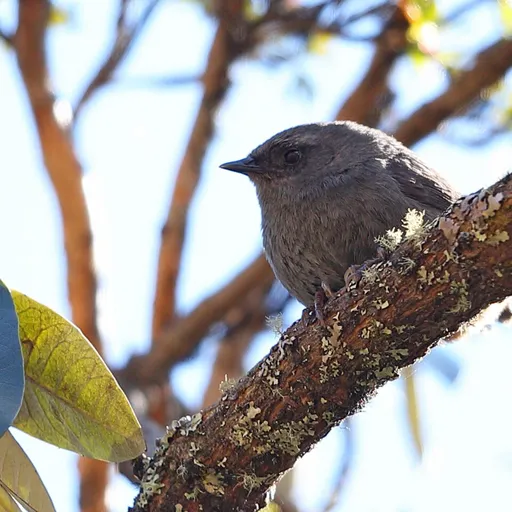
Puna Tapaculo
Scytalopus simonsi
Least Concern
Overview
The puna tapaculo (Scytalopus simonsi) is a small bird in the family Rhinocryptidae, endemic to the high-altitude Andes of Peru and Bolivia. It was formerly considered a subspecies or synonym of other tapacuños but is now recognised as a distinct species based on vocal differences.
Identification
- Size: 10 to 12 cm (3.9 to 4.7 in) long, with masses of 15.7 to 20 g.
- Plumage: Upper parts are gray, often washed with brown; throat and breast are gray; rump, flanks, and belly are cinnamon or olive-buff with dark bars.
- Markings: Features a narrow pale supercilium; the entire underside is barred; immatures are paler with a heavier brown wash.
- Voice: Song consists of descending churred phrases ('tcherr tcherr tcherr'); call is a descending whinny ('djee-ee-ee-eer').
Habitat
Inhabits the eastern slope of the Andes between 2,900 and 4,300 m, ranging from Peru's Cuzco Department to Bolivia's Cochabamba Department. It primarily occupies elfin forest at and above the tree line within small shrubs and trees among grass tussocks, as well as Polylepis woodlands.
Diet
The species is probably insectivorous, although it also consumes seeds. Very little is known about its specific foraging behaviour or detailed dietary composition.
Did you know?
Its status as a distinct species was only established after a 1997 study revealed differences in its vocalisations, having previously been treated as a subspecies of the Magellanic tapaculo or synonymous with Tschudi's tapaculo.
Sources
- Wikipedia · CC BY-SA 4.0
- Wikidata · CC0 1.0