
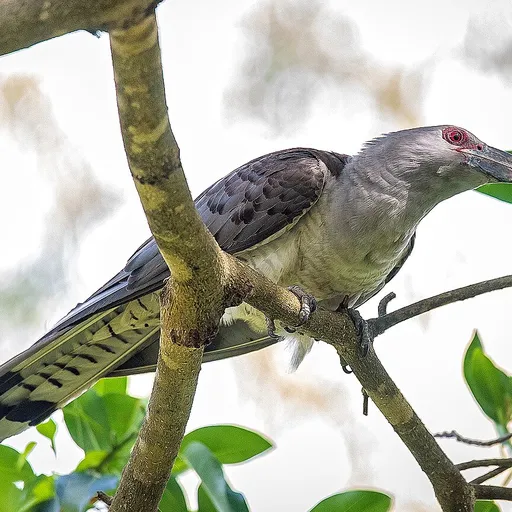
Channel-billed Cuckoo
Scythrops novaehollandiae
Least Concern
Listen
XC508459 · James Ray · Beaconsfield, Council of the City of Sydney, New South Wales, Australia · CC BY-SA 4.0
Overview
The channel-billed cuckoo (Scythrops novaehollandiae) is the largest cuckoo in the world and the biggest known brood parasite. It belongs to the family Cuculidae and is the sole member of its genus, Scythrops.
Identification
- Measures 56–70 cm in length with an 88–107 cm wingspan, weighing up to 935 g.
- Possesses a large, bi-coloured bill that is grey at the base and straw-coloured at the tip, resembling a hornbill.
- Adult plumage is pale grey with barred underparts, dark grey wings with dark tips, and a black banded tail.
- Features prominent red skin around the eyes and displays a distinctive hawk-like cross-shaped flight silhouette.
Habitat
Found across northern and eastern Australia, New Guinea, the Bismarck Archipelago, and eastern Indonesia. The species is migratory, moving between these regions seasonally, though some populations are permanent residents. It typically inhabits areas with large trees, often remaining in tree canopies.
Diet
Unusually for cuckoos, its diet is primarily frugivorous, consuming fruits from several species of Ficus, mistletoes, and introduced black mulberry. It also eats insects such as beetles, butterflies, and grasshoppers, and occasionally preys on bird nestlings and eggs. Foraging usually takes place in the canopy of large trees, sometimes in groups.
Did you know?
In northern Australia, the species' migration coincides with the start of the rainy season, leading to local names such as storm-bird, flood-bird, and rain-bird. Its frugivorous habits and raptor-like appearance have also earned it the nickname fig hawk.
Sources
- Wikipedia · CC BY-SA 4.0
- Wikidata · CC0 1.0