
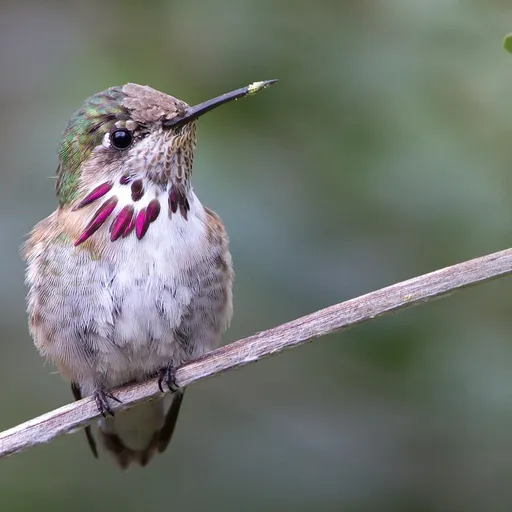
Calliope Hummingbird
Selasphorus calliope
Least Concern
Overview
The calliope hummingbird (Selasphorus calliope) is the smallest bird native to the United States and Canada. It is also recognised as the smallest known long-distance bird migrant, completing migrations of up to 9,000 km twice per year. Named after the Greek muse Calliope, this species was previously classified in its own genus, Stellula, but is now placed in Selasphorus.
Identification
- Adults measure 7–10 cm in length, span 11 cm across the wings, and weigh only 2 to 3 g, making them the smallest breeding bird in North America.
- Males feature glossy green backs and crowns, white underparts, green flanks, and a dark tail with distinctive wine-red streaks on the gorget that distend outwards during displays.
- Females and immatures display a pinkish wash on the flanks, dark streaks on the throat, and a dark tail with white tips.
- The prominent humming sound is generated by rapid wingbeats during flight and hovering, while courtship involves a loud buzzing created by accelerated wing frequency and fluttering tail feathers.
Habitat
Breeding occurs in western North America, ranging from southern British Columbia and Alberta down to Colorado and southern California, often in open montane forests, mountain meadows, and willow or alder thickets. Nesting altitudes vary significantly, from as low as 600 ft in Oregon and Washington to over 11,000 ft in the Rocky Mountains. During winter, the species migrates through the Southwestern United States and northern Mexico to wintering grounds in southwestern Mexico, utilising chaparral, lowland brushy areas, and desert regions.
Diet
Calliope hummingbirds feed primarily on nectar from flowers using a long extendable tongue, while also drinking sap from holes created by sapsuckers. They forage for insects on the wing and occasionally catch spiders. Preferred nectar sources include paintbrush, penstemon, columbine, trumpet gilia, and elephant head, with the birds simultaneously assisting in plant pollination.
Did you know?
The species achieves the status of the smallest-bodied long-distance migrant in the world, travelling exceptional distances of up to 9,000 km annually despite weighing only 2 to 3 g. During courtship, males accelerate their wingbeat to 95 flaps per second to produce a loud buzzing sound, and their nests are so finely constructed on pine cone bases that they closely resemble pine cones themselves.
Sources
- Wikipedia · CC BY-SA 4.0
- Wikidata · CC0 1.0