
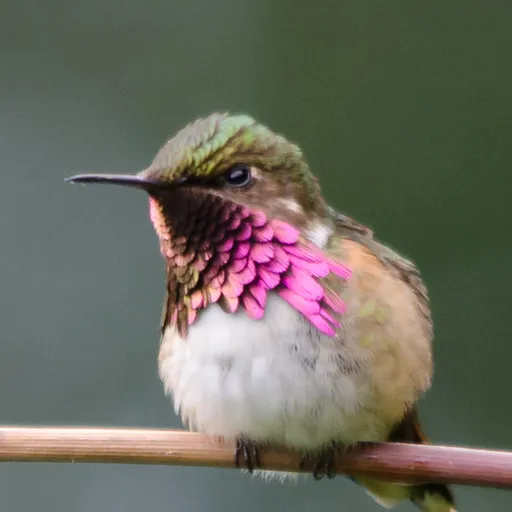
Wine-throated Hummingbird
Selasphorus ellioti
Overview
The wine-throated hummingbird (Selasphorus ellioti) is a small species of bee hummingbird found in Central America and southern Mexico. It is classified by some authorities in the genus Atthis and belongs to the tribe Mellisugini. The species comprises two subspecies, the nominate S. e. ellioti and S. e. selasphoroides, and is currently assessed as of Least Concern by the IUCN, though its population is believed to be decreasing.
Identification
- Length is 6.5 to 7 cm, with females weighing between 2 and 4 g.
- Both sexes possess a short, straight, blackish bill and a distinct small white spot behind the eye.
- Males of the nominate subspecies display glittering rose pink gorgets with violet highlights, while those of S. e. selasphoroides have greenish gorgets lacking blue or violet hues.
- Song consists of a series of high, slightly buzzy, squeaky chips that break into a warble, accompanied by a 'thrum' sound from hovering wings.
Habitat
This species inhabits montane landscapes, including the interiors, edges, and clearings of semi-humid to humid pine-oak and evergreen forests, as well as adjacent shrublands. It occurs at elevations between 1,500 and 3,500 m. The nominate subspecies is found in southern Mexico and Guatemala, while S. e. selasphoroides ranges through western Honduras and northern El Salvador.
Diet
The bird forages for nectar from various flowering plants, hovering to feed primarily at low to middle vegetation levels. It is assumed to consume small arthropods, consistent with the diet of most other hummingbirds, although specific dietary details are lacking.
Did you know?
Male wine-throated hummingbirds gather at dispersed leks to display for females, where they sing from exposed branches. Although little is known about the species' breeding phenology, the nesting season is thought to potentially extend from August to February.