
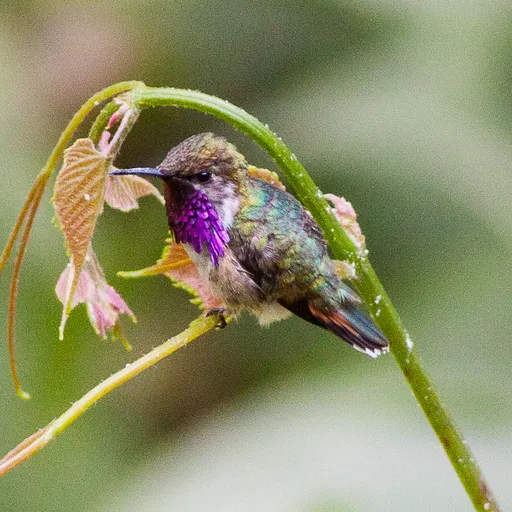
Bumblebee Hummingbird
Selasphorus heloisa
Overview
The bumblebee hummingbird (Selasphorus heloisa) is a species of hummingbird in the subfamily Trochilinae, commonly known as the 'bee hummingbirds'. It is endemic to Mexico but has occasionally appeared as a vagrant in the United States.
Identification
- Size: One of the smallest hummingbirds, measuring 5.9 to 7.5 cm (2.3 to 3.0 in) in length and weighing 2 to 2.7 g (0.071 to 0.095 oz).
- Bill & Markings: Features a short, straight, blackish bill and a distinct small white spot behind the eye.
- Plumage: Males display metallic bronze green to golden bronze upperparts and a metallic magenta purple to bluish purple gorget with flared hindward feathers; females have white throats with metallic bronze spots.
- Sound: The male's wings produce an insect-like buzz in flight, which is louder during courtship displays.
Habitat
This species inhabits montane landscapes between 1,500 and 3,000 m (4,900 and 9,800 ft) elevation, including the interiors, edges, and clearings of semi-humid to humid pine-oak and evergreen forest, cloudforest, and humid scrublands. It is found in both of Mexico's major mountain ranges, with the nominate subspecies in the east, central, and south, and subspecies S. h. margarethae in the northwest and west.
Diet
The bumblebee hummingbird forages for nectar from a wide variety of flowering plants, typically hovering horizontally with its tail cocked up at low to middle vegetation levels. It also consumes small arthropods and can sometimes feed in the territories of larger hummingbirds due to its small size.
Did you know?
Despite being generally considered sedentary, evidence suggests the bird makes seasonal movements between pine-oak forest and cloudforest habitats.