
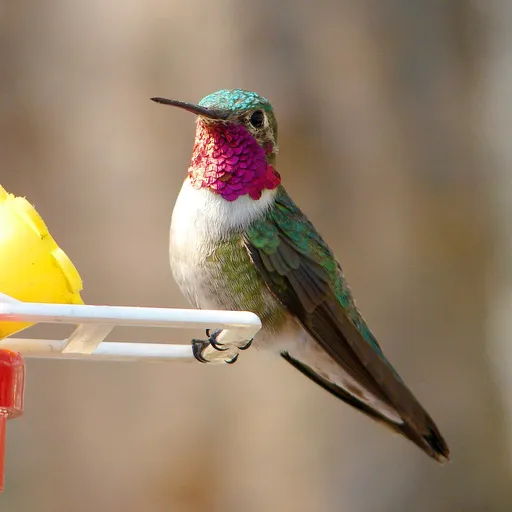
Broad-tailed Hummingbird
Selasphorus platycercus
Least Concern
Overview
The broad-tailed hummingbird (Selasphorus platycercus) is a medium-sized hummingbird found in highland regions ranging from western United States and Western Canada to Mexico and Guatemala. Classified as Least Concern by the IUCN, it maintains a large range and an estimated population of 9.8 million individuals, though surveys indicate a 52% decline between 1966 and 2015.
Identification
- Adults feature an iridescent green back, a white eye ring, and a rounded black tail that projects beyond the wing tips.
- The species is sexually dimorphic, with males displaying a bright rose-red gorget, while females possess paler coloration, cinnamon flanks, and spotted cheeks.
- Males produce a sharp "cheet" call repeated in sequence, along with buzzing "wing trills" generated during courtship displays that can be heard up to 75 m away.
Habitat
This species inhabits the understory of pine and oak woodlands, as well as open areas with flowers or grasslands among trees and shrubs. Breeding habitats primarily consist of subalpine meadows, foothills, montane valleys, and stands of aspen or spruce.
Diet
The diet consists mainly of insects and nectar from "hummingbird-flowered" plants, which are characterised by high nectar production, red corollas, and a tubular shape, such as Aquilegia elegantula.
Did you know?
Males produce a buzzing "wing trill" by forcing air rapidly through the 9th and 10th primary feathers; experiments show that males lacking this specific sound lose their territories more easily to aggressive competitors.
Sources
- Wikipedia · CC BY-SA 4.0
- Wikidata · CC0 1.0