
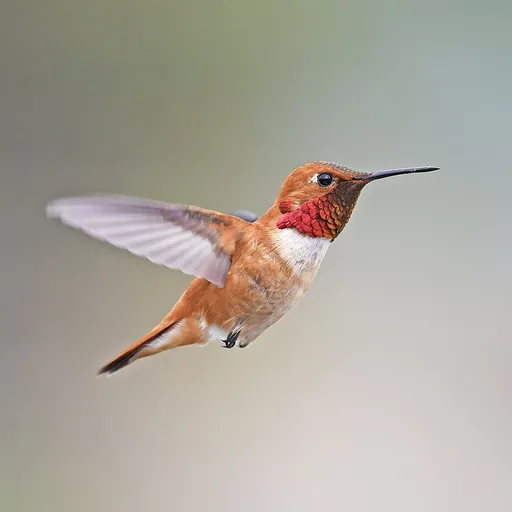
Rufous Hummingbird
Selasphorus rufus
Near Threatened
Overview
The rufous hummingbird (Selasphorus rufus) is a small hummingbird found in western North America, notable for its extraordinary flight skills. As a Near Threatened species, it faces risks from insect population declines and climate change affecting blooming times.
Identification
- Adult males possess a white breast, rufous face, flanks, and tail, with an iridescent orange-red throat patch (gorget).
- Females exhibit green, white, and iridescent orange feathers on the throat, alongside a dark tail with white tips and a rufous base.
- The bird is small, measuring 7–9 cm in length and weighing only 2–5 g, with a long, straight, and slender bill.
- A 'notched' shape on the second rectrix helps distinguish adult males from the similar Allen's hummingbird.
Habitat
Breeding habitats include open areas, mountainsides, and forest edges in western North America, ranging from southern Alaska to California. Most individuals winter in wooded areas in the Mexican state of Guerrero, completing a transcontinental migration of over 3,200 km.
Diet
The bird feeds on nectar from flowers using a long extendable tongue and catches insects on the wing. It requires frequent feeding during the day and becomes torpid at night to conserve energy.
Did you know?
To support body weight while hovering, these birds rely on wing downstrokes for 75% of lift and upstrokes for 25%. They can rapidly switch from fat metabolism to carbohydrate metabolism within 40 minutes of feeding on nectar.
Sources
- Wikipedia · CC BY-SA 4.0
- Wikidata · CC0 1.0